
Our day-to-day work involves issues relating to the assessment of soil-thermal and hydrogeological conditions, and the determination of the thermal parameters of soils and rocks, both in the field and in the laboratory, for the purposes of construction, spatial planning and the development of underground space in the design of underground energy infrastructure.
A significant part of our work involves the production of a series of Shallow Geothermal Energy Potential Map at a scale of 1:50,000, which aids in the design of heat pump systems. The results of our work can be used in the development of local strategies for renewable energy sources or plans to reduce CO₂ emissions.
We are also involved in developing concepts and supporting initiatives related to thermal energy storage.
We are the authors of several manuals, guidelines, monographs and articles in which we seek to explain the most important aspects of shallow geothermal energy and engineered geothermal systems.
ABOUT GEOTHERMAL
Shallow geothermal energy refers to geothermal energy sources where the temperature is not high enough to recover thermal energy without the use of specialised technologies. These technologies rely on a stable temperature and are used for heating (and/or cooling) buildings, including both detached houses and entire housing estates, public buildings and industrial facilities, as well as for heat storage in rock formations.
Low-temperature geothermal energy is shallow geothermal energy, a form of renewable energy (RES) that is clean and emission-free, and is utilised in practice through the use of ground-source heat pumps (GSHPs) (Kapuściński, Rodzoch 2010; Rubik 2011; Ryżyński, Kozdrój, Szlasa (eds.) et al. 2023).
Geothermal Engineering is a branch of geothermal energy involved in work and research concerning:
- extracting heat and cooling from the rock mass,
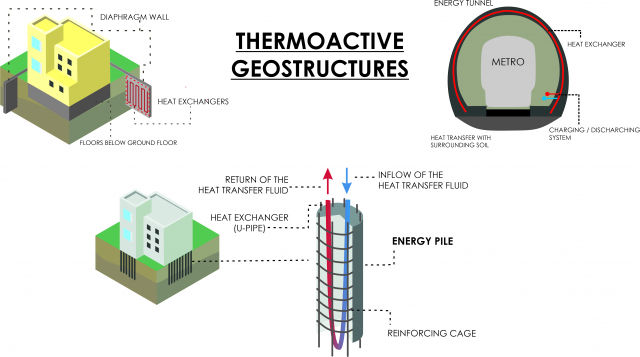
- utilising the thermal energy stored in the shallowest layers of the rock mass through heating systems that use energy foundations based on ground-source heat pumps,
- assessing the thermal properties of the building subsoil.
Shallow geothermal energy in practice
Shallow geothermal energy is primarily used for heating (and/or) cooling both detached houses and entire housing estates, as well as public, commercial or industrial buildings, using ground-source heat pump technology.
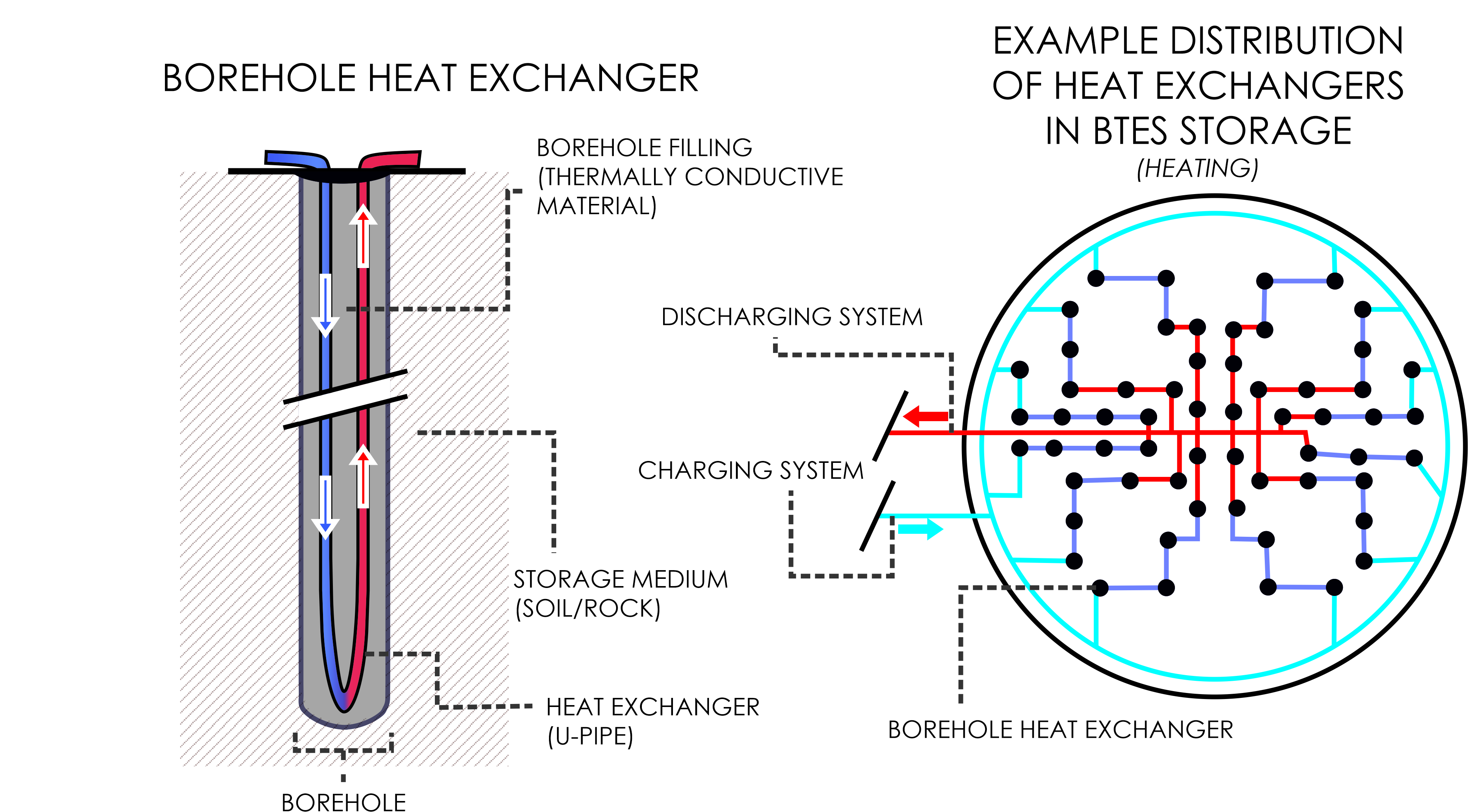
For this purpose, boreholes (known as borehole heat exchangers) are used, ranging in depth from several dozen metres to 150-200 metres, although they usually reach a depth of 100 metres. Their depth and number depend on the existing soil and groundwater conditions. Different types of soil and rock vary in terms of thermal conductivity, which directly affects how quickly the working fluid in the heat pump system heats up.
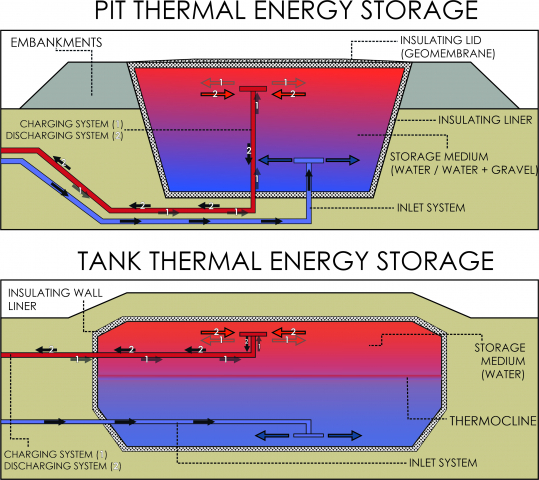
Furthermore, soils and rocks differ in terms of their heat capacity, which can be utilised for underground thermal energy storage. Thermal energy storage systems enable the utilisation of surplus energy, waste heat and energy generated by renewable energy installations for later use. Using specialised systems, surplus electricity is converted into thermal energy, which can then be injected (stored) underground during warm seasons and recovered during the heating season. Alternatively, cold from cool winter air or cold extracted from water by a heat pump during the heating season can be injected and recovered during the summer for air conditioning.
Geothermal energy, based on heat pump systems, is becoming increasingly popular due to its energy efficiency, low long-term running costs and compact size, which saves space above ground. Furthermore, it offers an alternative to traditional heating and cooling systems, as it utilises a renewable energy source, helping to reduce energy consumption and cut CO₂ emissions. This makes it an effective tool in the fight against smog.
Types of geothermal energy:
based on the temperature of geothermal waters:
- low-temperature geothermal energy:
- water temperature up to 30°C,
- water used primarily for heating buildings;
- medium-temperature geothermal energy:
- water temperature in the range of 30-150°C,
- the water can be used for electricity generation and heat production;
- high-temperature geothermal energy:
- water temperature above 150°C,
- the water is most commonly used for electricity generation and in industrial heating processes;
based on the depth at which geothermal resources are found:
- shallow geothermal energy (low-temperature):
-
up to a depth of 200 m,
-
most commonly used with ground-source heat pumps (GSHPs) for heating and cooling buildings,
-
temperatures ranging from 10-30 °C;
-
- deep geothermal energy (medium- and high-temperature):
-
at depths of over 200 m,
-
can be used for district heating and for electricity generation,
-
temperatures above 100°C;
-
based on the technology used:
- ground-source heat pumps (GSHPs):
-
utilise shallow geothermal energy,
-
used for heating and cooling buildings,
-
systems can be vertical (geothermal probes) or horizontal (geothermal collectors);
-
- underground thermal energy storage systems (Geothermal Engineering):
-
utilise shallow and low-temperature geothermal energy,
-
used for heating and cooling buildings,
-
may be tankless (BTES) or tank-based (TTES, PTES);
-
- energy foundations (thermoactive structures) (Geothermal Engineering):
-
utilise shallow, low-temperature geothermal energy,
-
used for heating and cooling buildings,
-
may function as underground tankless heat storage systems;
-
- geothermal power stations:
-
utilise deep and high-temperature geothermal energy,
-
used to generate electricity, primarily in areas with high geothermal potential;
-
-
hybrid systems:
-
a combination of geothermal energy and other renewable energy sources (e.g. solar energy, biomass),
-
used to improve energy efficiency
-