













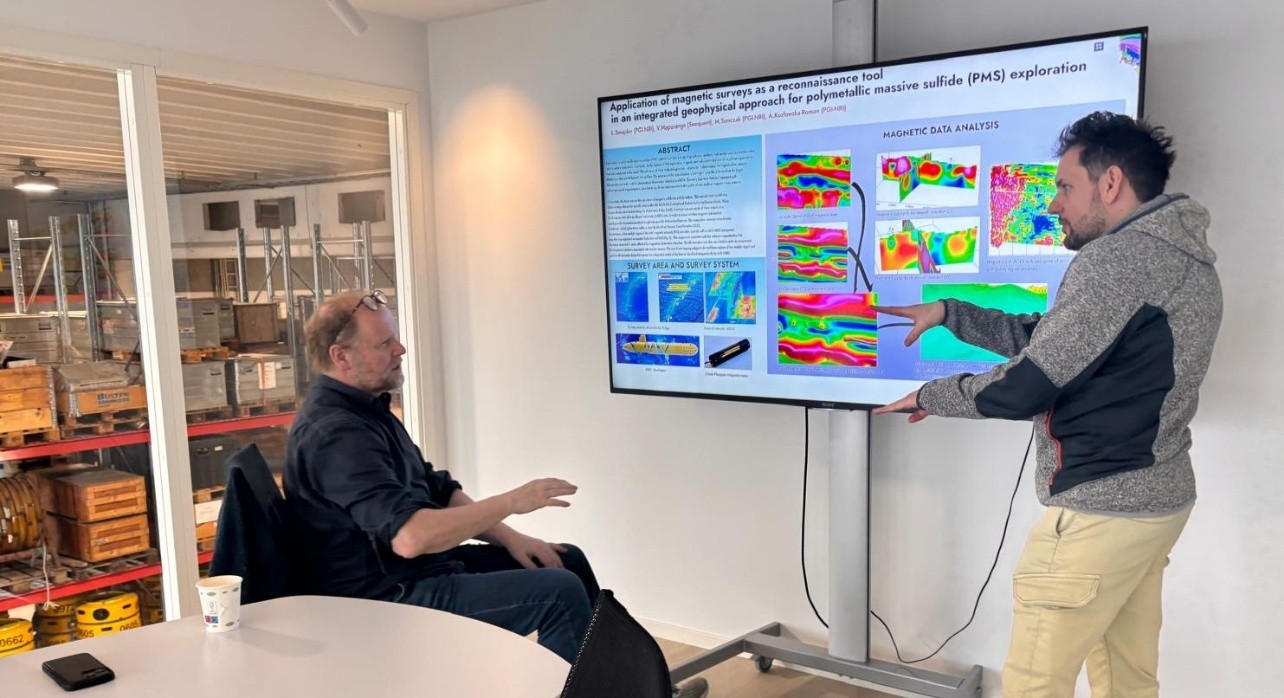
 A conference on deep-sea deposits – Seabed Minerals (formerly DeepSeaMinerals) – took place in Bergen (Norway) from 24 to 26 March 2026. The event, organised for the fifth time, brought together representatives from the scientific community, exploration and service companies, and public authorities – both Norwegian and international – with an interest in the exploration and exploitation of deep-sea polymetallic deposits.
The last two editions of the conference were held under the theme ‘Critical knowledge, critical technology, critical minerals’.
The programme has been divided into seven main thematic sections. The opening session featured an update from Letícia Carvalho, Secretary-General of the International Seabed Authority (ISA), which was then elaborated upon by Sissel Eriksen, Chair of the ISA Legal and Technical Commission.
The Polish Geological Institute – National Research Institute (PGI-NRI) was represented by Dr Michał Tomczak and Łukasz Smajdor, who presented a paper entitled ‘Application of magnetic surveys as a reconnaissance tool in an integrated geophysical approach for polymetallic massive sulphide (PMS) exploration’ by Łukasz Smajdor (PGI-NRI), Victor Mapuranga (Bentley-Sequest), Michał Tomczak (PGI-NRI) and Agata Kozłowska-Roman (PGI-NRI). They presented the results of research conducted within the Polish contract area in the Atlantic, specifically an analysis of magnetic data using an innovative multi-attribute approach, with the aim of identifying potential accumulations of inactive massive sulphides. They also discussed the ‘blind test’ (an analysis of the data without prior knowledge) carried out on magnetic data from cluster A within Area of Interest 1 (AOI-1), which is the newly discovered OCC (Oceanic Core Complex). The results of the test enabled the identification of hydrothermal structures also visible in high-resolution MBES (Multibeam Echosounder) and SAS (Synthetic Aperture Sonar) data collected from an AUV (Autonomous Underwater Vehicle) in 2023.
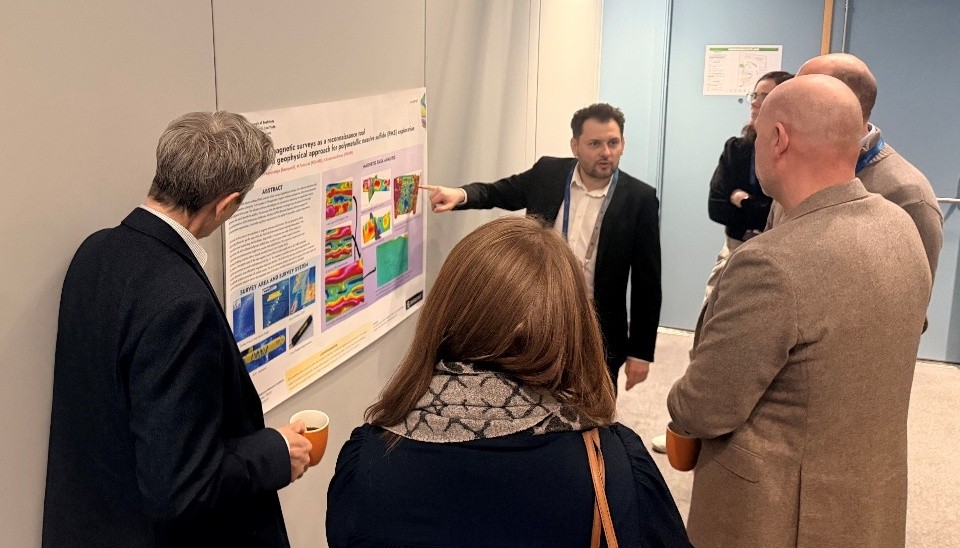
Łukasz Smajdor presenting the results of the Polish team’s work in Cluster A of the AOI-1 area
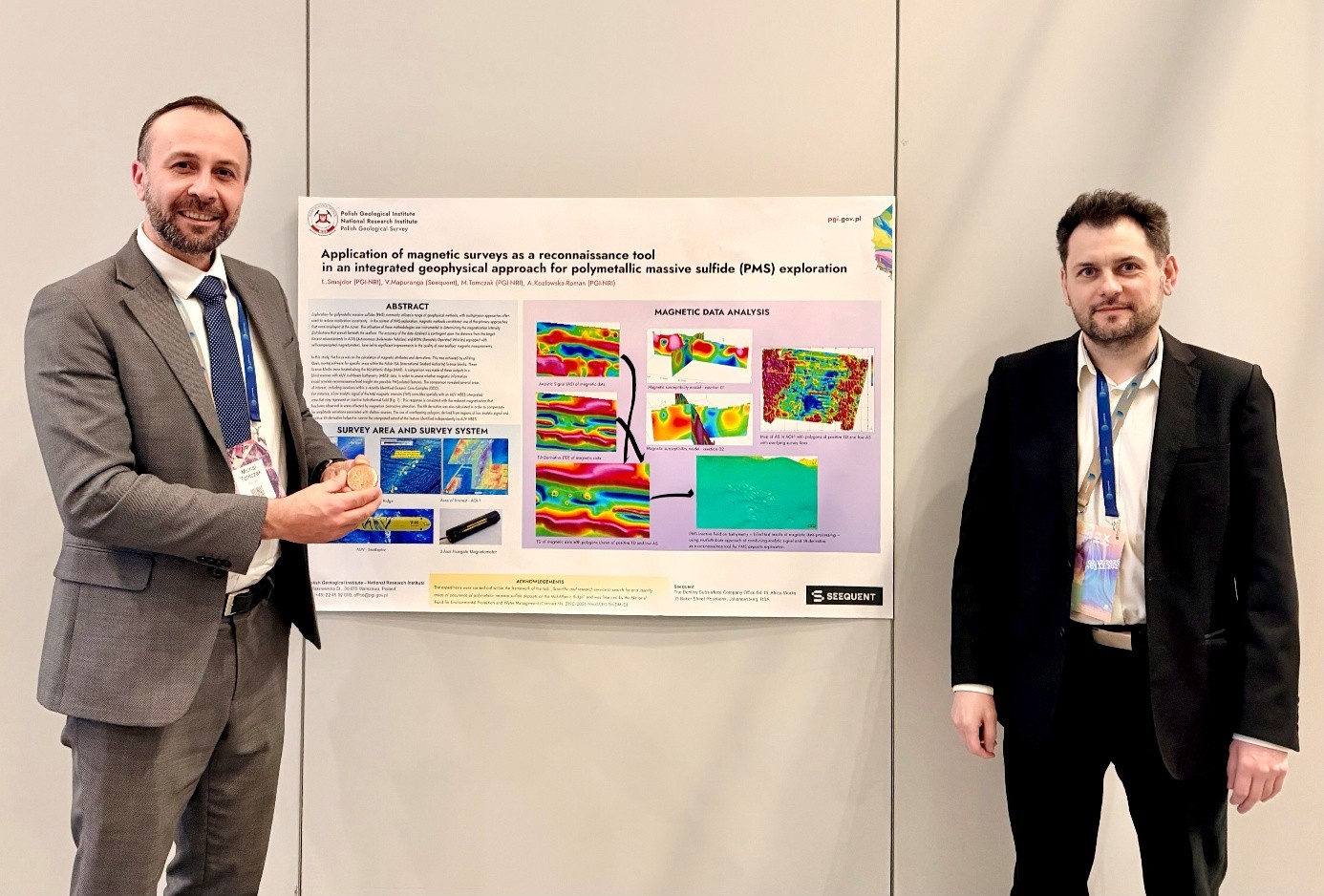
Dr Michał Tomczak (left) and Łukasz Smajdor with the first copper sample extracted from the massive sulphides of the Gygra deposit (discovered in 2024 at a depth of 2,800 metres within the Knipovich Ridge)
Furthermore, the first iteration of the VOXI (Voxel Inversion) magnetic inversion, carried out using Seequent’s Oasis software, not only confirmed the previously identified sites but also identified new ones, which are still being analysed. The identified areas – both those identified in situ during the operation of the autonomous underwater vehicle and those derived from detailed data processing – will be verified and subjected to further measurements and geological sampling using the Portuguese remotely operated underwater vehicle (ROV) Luzo 6000, during a research cruise planned to be carried out jointly with the Spanish geological service in September 2026.
Text: Łukasz Smajdor, Michał Tomczak
Photos: Łukasz Smajdor, Michał Tomczak, Jon Oddvar Hellevang, Maja Lian Jœger, Dr Håvard Hallås Stubseid, emimnent-project.com
 PGI-NRI offer
 Mineral resources of Poland
  Oil and Gas in Poland


 Subscribe to RSS Feed