










 The annual European Geosciences Union (EGU) conference, one of the most important scientific events dedicated to Earth and environmental sciences, took place from 3 to 8 May 2026. This year’s edition attracted 22,497 participants from 125 countries. As part of 1,014 thematic sessions, 20,173 papers were presented, of which 2,470 took place online.
One of the dominant themes of this year's conference was the use of artificial intelligence (AI) and large language models (LLMs) in Earth sciences. Discussed also ethical issues related to the implementation of AI tools, emphasizing that new technologies should support, rather than replace, the work of geologists and natural scientists based on field and laboratory research.
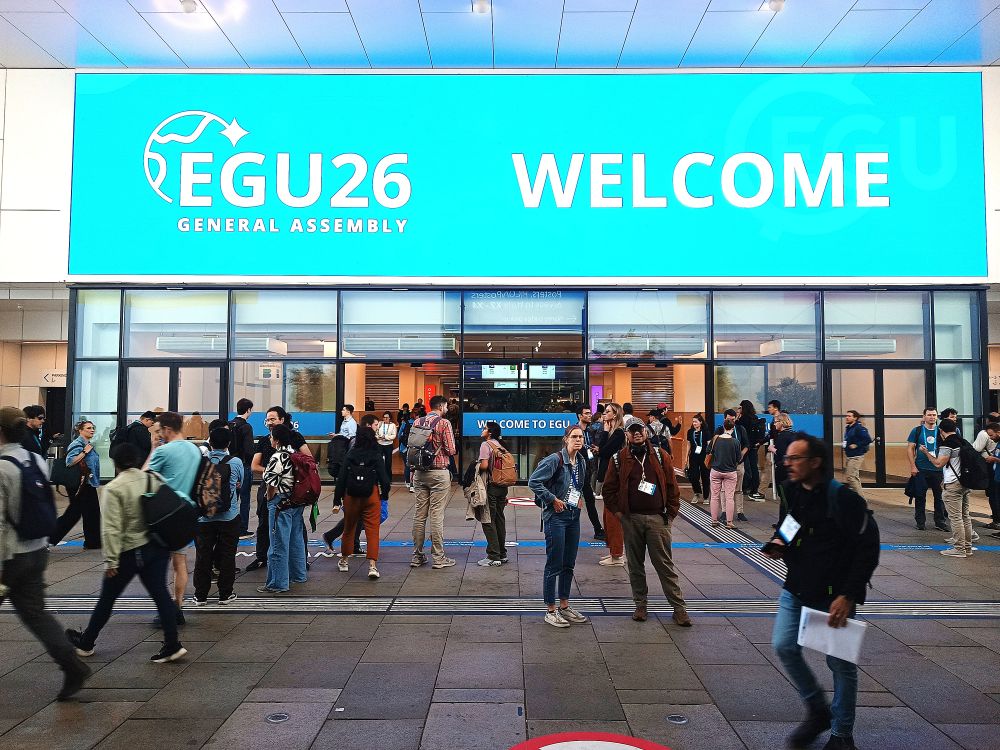
Main entrance to the conference
Discussed also ethical issues related to the implementation of AI tools, emphasizing that new technologies should support, rather than replace, the work of geologists and natural scientists based on field and laboratory research.
The Polish Geological Institute – National Research Institute was represented by Karolina Idzikowska, Bartłomiej Grochmal, Tatiana Solovey, Urszula Stępień and Urszula Hara.
Karolina Idzikowska co-chaired the oral and poster session ‘Carbonates – archives of time, space and change’, devoted to research of sediments and carbonate rocks and their significance for reconstructing climatic, environmental, and oceanographic changes in Earth’s history. The session covered sedimentary and diagenetic processes, high-resolution stratigraphic records, and modern and fossil carbonate depositional systems. As part of the session, she also presented a poster entitled ‘Carbon isotope record across the Lower–Middle Triassic transition in the Holy Cross Mountains (Poland): chemostratigraphic and palaeoenvironmental significance’.
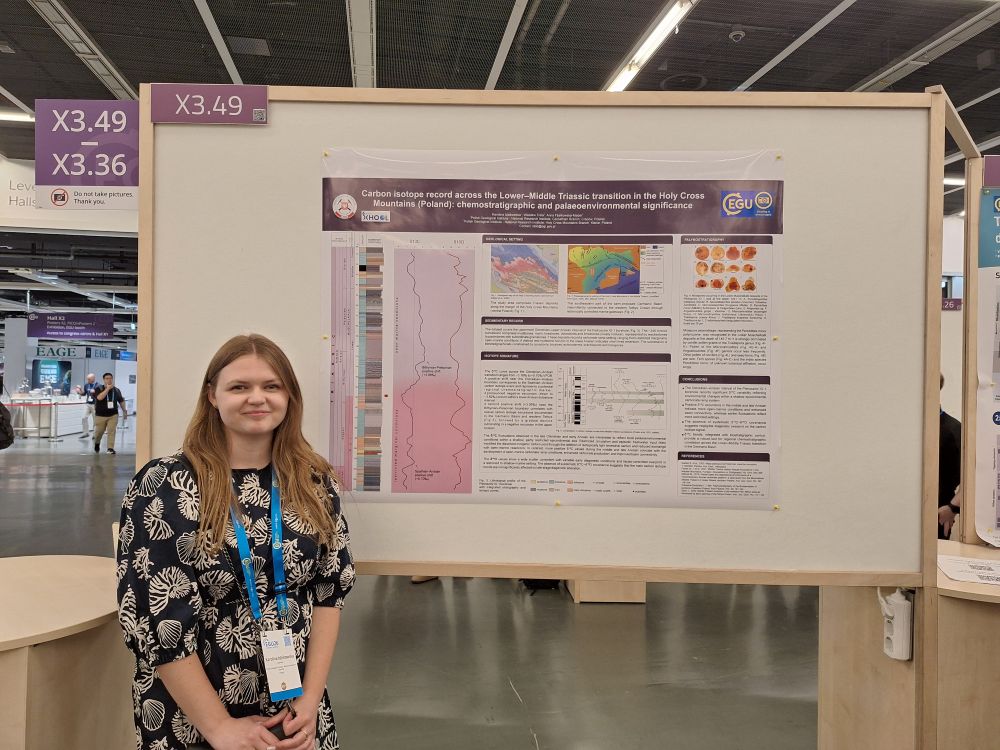
Karolina Idzikowska presents a poster
Bartłomiej Grochmal discussed, on behalf of the team, a poster entitled ‘Quaternary neotectonic activity of the Sudetic Marginal Fault in the Pieszyce area, Góry Sowie Massif (NE Bohemian Massif, SW Poland)’. Presented results of geological, sedimentological, and mineralogical studies revealed clear evidence of tectonic activity along the Sudetic Marginal Fault in the Pieszyce area during the Quaternary.
Tatiana Solovey was a co-author of two papers. The first of these, ‘Reconstructing GRACE Terrestrial Water Storage Anomalies Time Series Using Bias-Aware Machine Learning’, concerned the application of machine learning methods and statistical models to reconstruct missing GRACE satellite data on total water resources in the Bug river basin. The research also included an assessment of the effectiveness of these methods in hydrological analyses.
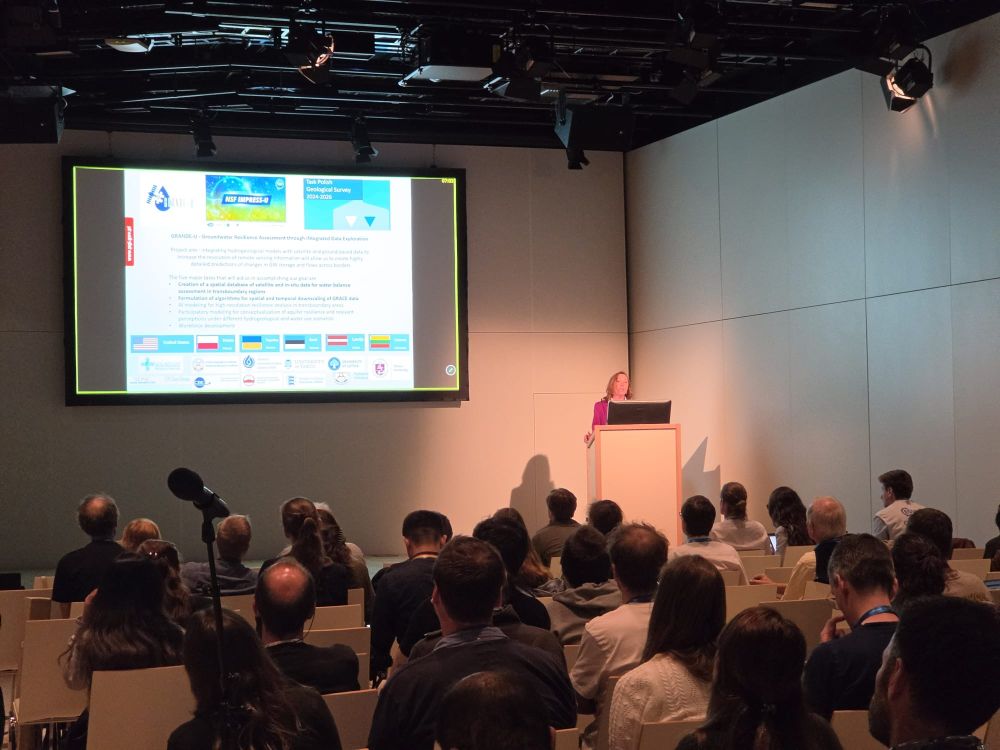
Presentation by Tatiana Solovey
The second paper, ‘Driving Factors of Groundwater Storage Variability in the Transboundary Bug River Basin’, was presented by co-author Justyna Śliwińska-Bronowicz from the Space Research Centre of the Polish Academy of Sciences. It concerned an analysis of changes in groundwater resources in the Bug River basin using field data and GRACE and GRACE-FO satellite data, with particular emphasis on the impact of climatic and hydrogeological factors on the variability of water resources.
Urszula Stępień delivered a paper entitled ‘In Search of Lithological Truth – Sceptical Non-Geologists in the Non-English Speaking World’, drawing attention to the problem of limited access to publicly available scientific publications in national languages and the discrepancies between machine translations and the actual meaning of lithological terms. During informal discussions, it was confirmed that many European geological surveys are facing similar challenges.
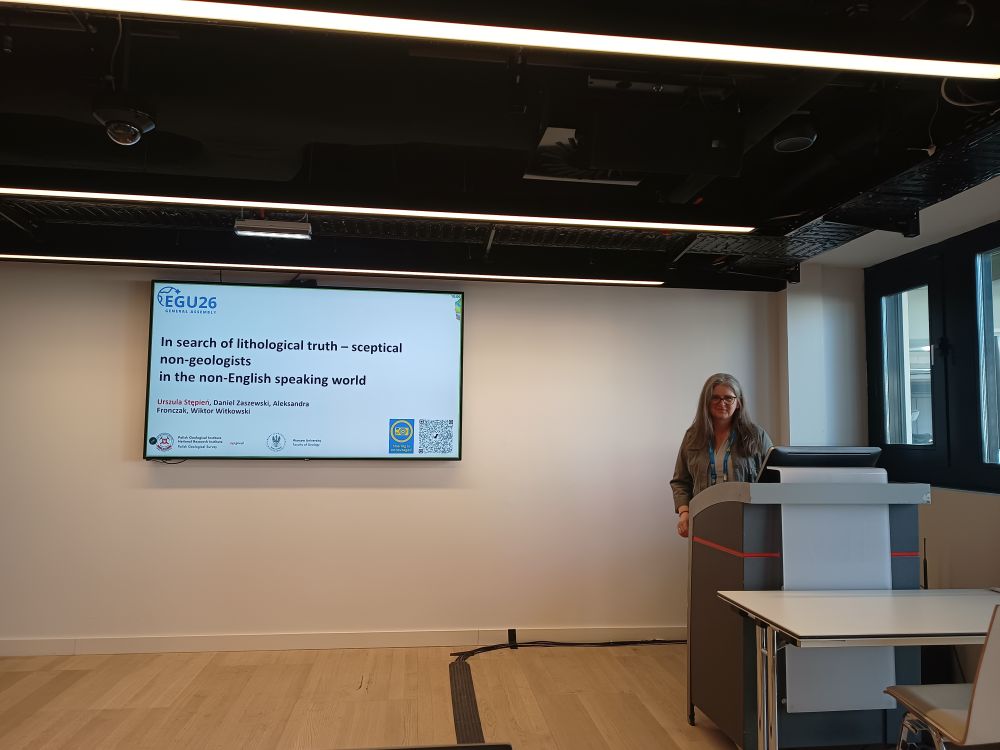
Urszula Stępień during her speech
The second presentation, co-authored by Urszula Stępień and entitled ‘Geological Maps and Data Gaps Assessment: The Key Factors for a Solid Geological Background’, was delivered by Hans-Georg Krenmayr from GeoSphere Austria. This paper focused on an inventory of geological maps produced by European geological surveys and the identification of gaps requiring data supplementation and refinement. Emphasised the need for semantic organisation of information on geological units and structures across administrative boundaries.
It is also worth noting the participation of scholarship holders Szymon Mol and Jerzy Gamdzyk, who presented research results conducted under the supervision of Marcin Dąbrowski as part of the NCN POLARIS grant. Szymon Mol delivered a paper entitled ‘Numerical Modelling of Viscous Folding in a Layered Sedimentary Cover Above a Basement Fault’, discussing results of numerical simulations of deformation processes occurring above an active basement fault. Jerzy Gamdzyk delivered a poster entitled ‘Viscous Folding of Multilayer Rocks Under Layer-Parallel Shortening: Discrete Layering vs. Anisotropic Models’, summarising the results of theoretical and numerical analyses of folding processes in a multilayer medium.
From the perspective of the state geological service’s remit, issues related to open data, the implementation of the FAIR principles and the use of large language models attracted particular interest. During the consultation, provided a number of practical guidelines on implementing the FAIR standards, along with an invitation to take part in workshops organised by Earth Science Information Partners (ESIP).
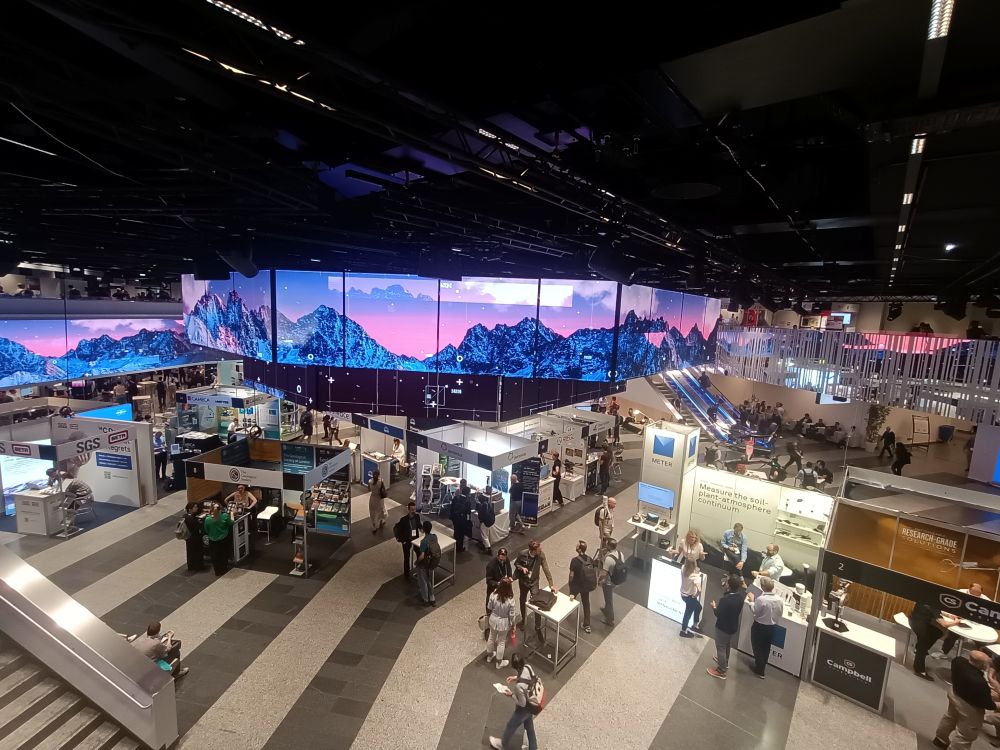
Conference hall with exhibitions and information stands
During session CL1.1.1, ‘Past Climate Change and Carbon Cycle: Insights from Models and Proxies’, Urszula Hara delivered a paper entitled ‘Palaeoenvironmental and Climatic Event (EECO–EOT) in the Bryozoan Fossil Record of the Early Cenozoic of Antarctica’. The results of the palaeontological research presented, supported by geochemical analyses, confirmed earlier palaeobotanical data indicating a gradual cooling of the climate at the turn of the Eocene and Oligocene.
Text and photos: Urszula Stępień, Aleksandra Fronczak, Karolina Idzikowska, Tatiana Solovey, Urszula Hara, Marcin Dąbrowski
List of publications by present and retired staff of PGI-NRI at EGU:
- Gamdzyk, J. and Dąbrowski, M.: Viscous folding of multilayer rocks under layer-parallel shortening: discrete layering vs. anisotropic models, EGU General Assembly 2026, Vienna, Austria, 3–8 May 2026, EGU26-15192, https://doi.org/10.5194/egusphere-egu26-15192, 2026.
- Grochmal, B., Sobczyk, A., Słomski, P., Belzyt, S., Kowalski, A., Badura, J., Fiałkiewicz, M., and Dąbrowski, M.: Quaternary neotectonic activity of the Sudetic Marginal Fault in Pieszyce area, Góry Sowie Massif (NE Bohemian Massif, SW Poland) , EGU General Assembly 2026, Vienna, Austria, 3–8 May 2026, EGU26-10571, https://doi.org/10.5194/egusphere-egu26-10571, 2026.
- Hara, U.: Palaeoenvironmental and climatic events (EECO-EOT) in the bryozoan fossil records of the Early Cenozoic of Antarctica, EGU General Assembly 2026, Vienna, Austria, 3–8 May 2026, EGU26-21840, https://doi.org/10.5194/egusphere-egu26-21840, 2026.
- Idzikowska, K., Trela, W., and Fijałkowska-Mader, A.: Carbon isotope record across the Lower-Middle Triassic transition in the Holy Cross Mountains (Poland): chemostratigraphic and palaeoenvironmental significance, EGU General Assembly 2026, Vienna, Austria, 3–8 May 2026, EGU26-19481, https://doi.org/10.5194/egusphere-egu26-19481, 2026.
- Le Guern, C., Schokker, J., Stępień, U., Walstra, J., Heckmann, P., Asch, K., and Krenmayr, H.-G.: An international vocabulary for anthropogenic deposits to improve geological mapping and modelling, EGU General Assembly 2026, Vienna, Austria, 3–8 May 2026, EGU26-16704, https://doi.org/10.5194/egusphere-egu26-16704, 2026.
- Mol, S. and Dabrowski, M.: Numerical modelling of viscous folding in a layered sedimentary cover above a basement fault, EGU General Assembly 2026, Vienna, Austria, 3–8 May 2026, EGU26-6922, https://doi.org/10.5194/egusphere-egu26-6922, 2026.
- Solovey, T., Śliwińska-Bronowicz, J., Samalavičius, V., and Stradczuk, A.: Reconstructing GRACE Terrestrial Water Storage Anomalies time series using Bias-Aware Machine Learning, EGU General Assembly 2026, Vienna, Austria, 3–8 May 2026, EGU26-1991, https://doi.org/10.5194/egusphere-egu26-1991, 2026.
- Stępień, U., Krenmayr, H.-G., Asch, K., Heckmann, P., Piessens, K., Capova, D., Kramolisova, P., and Mancebo, M.: Geological Maps and Data Gaps Assessment: The Key factors for a Solid Geological Background, EGU General Assembly 2026, Vienna, Austria, 3–8 May 2026, EGU26-8882, https://doi.org/10.5194/egusphere-egu26-8882, 2026.
- Stępień, U., Zaszewski, D., Fronczak, A., and Witkowski, W.: In search of lithological truth – sceptical non-geologists in the non-English speaking world, EGU General Assembly 2026, Vienna, Austria, 3–8 May 2026, EGU26-6989, https://doi.org/10.5194/egusphere-egu26-6989, 2026.
- Śliwińska-Bronowicz, J., Solovey, T., Stradczuk, A., Janica, R., and Brzezińska, A.: Driving factors of groundwater storage variability in the transboundary Bug River Basin, EGU General Assembly 2026, Vienna, Austria, 3–8 May 2026, EGU26-4930, https://doi.org/10.5194/egusphere-egu26-4930, 2026.
 PGI-NRI offer
 Mineral resources of Poland
  Oil and Gas in Poland


 Subscribe to RSS Feed