











 On 3 August 2026, an agreement was signed for the implementation of the GEO-H2-PL project under GOSPOSTRATEG XIII, the Strategic Programme for Scientific Research and Development Works financed by the National Centre for Research and Development (NCBR).
The winning consortium consists of three institutions:
- AGH University of Science and Technology in Cracow (consortium leader),
- Polish Geological Institute – National Research Institute (PGI-NRI),
- Mineral and Energy Economy Research Institute of the Polish Academy of Sciences (MEERI PAS / IGSM PAN).
The three-year project, entitled “A program for the exploration, recognition and development of natural hydrogen deposits for the purpose of shaping Poland's raw materials and energy policy” (GEO-H2-PL), has a budget of nearly PLN 17 million. The project leader is Prof. Henryk Sechman, D.Sc., AGH University of Science and Technology. Project activities on behalf of PIG-PIB and IGSM PAN will be coordinated respectively by Dr Krystian Wójcik and Dr Eng. Bogusław Bielec. This is the first large-scale and highly prestigious research project undertaken by PGI-NRI in almost a decade. Organizational and scientific oversight will also be provided by Prof. Krzysztof Szamałek, Director of PIG-PIB, and Jarosław Zacharski, M.Sc., an expert in petroleum exploration, both of whom are members of the Steering Committee.
Natural hydrogen: the subject of research and the beginning of cooperation
In the global energy transition, whose ultimate goal is widespread reliance on renewable energy sources, hydrogen is increasingly regarded as a clean, environmentally friendly and widely available fuel. Hydrogen can be produced through, for example, water electrolysis using renewable energy (so-called green or yellow hydrogen) or through processing of natural gas and coal (grey, brown, or black hydrogen). However, one potentially important source still remains largely overlooked: geological (natural) hydrogen, naturally accumulated within the Earth’s crust. Hydrogen commonly occurs within mineral and rock inclusions. More importantly, it may accumulate as free gas in structures analogous to natural gas fields, occur together with hydrocarbons, or be dissolved in deep saline waters.
Do such accumulations occur in Poland, and if so, what could their economic significance be? This question was first raised in 2022 by specialists from the former Department of Geology and Geological Concessions of the Ministry of Climate and Environment. At that time, reports of the first and, so far, only documented deposit of pure hydrogen in Bourakébougou, Mali, and subsequent discoveries of major natural hydrogen resources in the Lorraine Basin in France, were only beginning to attract international attention. These developments inspired PGI-NRI to launch investigations into the natural hydrogen potential of Poland as part of the activities of the Polish Geological Survey, financed by the National Fund for Environmental Protection and Water Management. Similar research efforts were already underway at AGH and IGSM PAN. It quickly became evident that the occurrence of natural hydrogen in Poland, its distribution, and the complex geological systems responsible for its formation required a broad interdisciplinary research effort beyond the capabilities of any single institution. This led to the establishment of a formal partnership. The cooperation officially commenced in October 2024 with the creation of the Polish Natural Hydrogen Initiative, established under the patronage of the Ministry of Climate and Environment. In addition to AGH, PGI-NRI and MEERI PAS, the initiative also includes ORLEN S.A. The GEO-H2-PL project funded by the NCBR is the first major outcome of this collaboration.
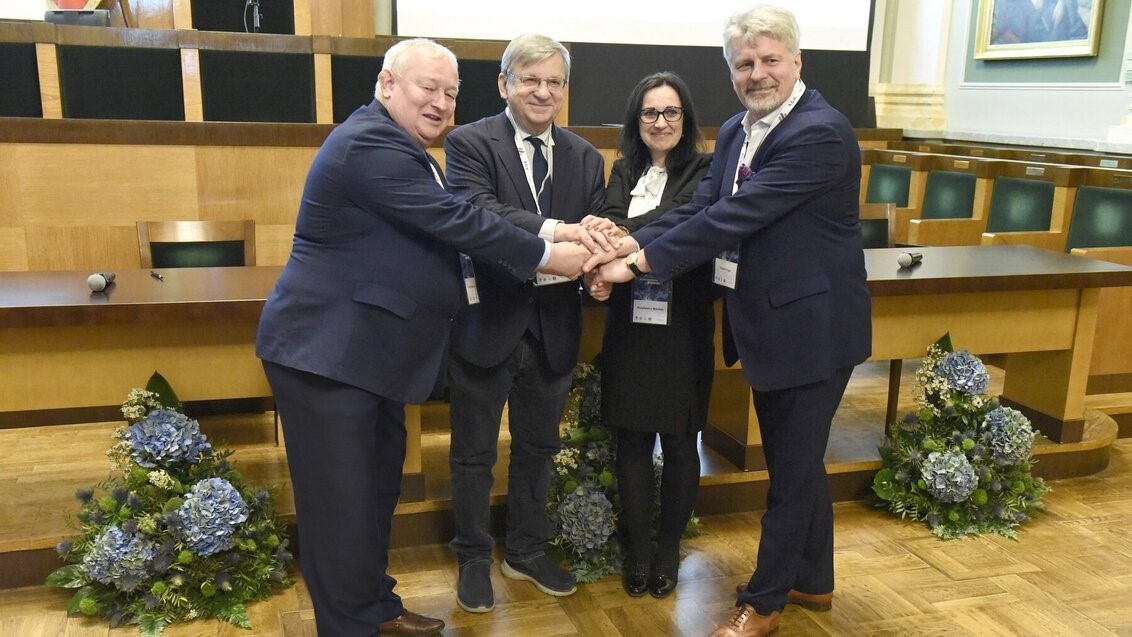
Establishment of the Polish Natural Hydrogen Initiative in 2024. Signatories to the agreement (from left): Prof. Rafał Wiśniowski, D.Sc., Eng. (Vice-Rector for Cooperation, AGH University of Science and Technology), Prof. Krzysztof Szamałek, D.Sc. (Director, Polish Geological Institute – National Research Institute, PGI-NRI), Prof. Magdalena Wdowin, D.Sc., Eng. (Director, Mineral and Energy Economy Research Institute of the Polish Academy of Sciences, MEERI PAS), and Dr Eng. Wiesław Prugar (Member of the Management Board for Upstream, ORLEN S.A.). Photo: Zbigniew Sulima
Natural hydrogen exploration programme in Poland
Numerous locations around the world exhibit natural hydrogen emissions, sometimes on a spectacular scale, e.g. deep-sea hydrothermal vents ("white" and "black smokers") along mid-ocean ridges, volcanic exhalations, geyser eruptions, geological processes associated with magmatic, metamorphic and hydrothermal activity, maturation and decomposition of organic matter, or rock weathering processes. Although such active hydrogen-generating systems do not currently occur in Poland, similar processes undoubtedly took place in the geological past during billions of years of crustal evolution in this part of Europe. These processes may have created hydrogen accumulations that remain undiscovered today.
Fairy circles – vegetation-free, closed depressions, ranging from several tens to several hundreds of metres in diameter and up to one metre deep – are currently considered to be surface manifestations of hydrogen seepage from deep subsurface sources. Searching for such structures is among the simplest methods of identifying hydrogen accumulations and will form an important component of the AGH team's work. At the same time, research will focus on hydrogen occurring as an admixture in Polish natural gas reservoirs. The presence of hydrogen admixtures has been documented by the Polish Geological Survey in nearly all major gas-bearing horizons in Poland, and these issues will be investigated by the PGI-NRI research team. Another crucial research area concerns hydrogen dissolved in formation brines, particularly in light of recent discoveries in Lorraine, France. These studies will be conducted by MEERI PAS.
Together, these efforts will enable the estimation of Poland’s natural hydrogen resources, identification of the most prospective exploration areas, and development of methodologies for future exploration activities. Then, the project’s most visible and challenging phase will begin. In three locations where geological and environmental evidence strongly suggests the presence of hydrogen accumulations, including surface hydrogen seepage, PGI-NRI will drill three fully cored boreholes. By drilling through potential hydrogen migration pathways, these boreholes will help verify the existence of deep hydrogen reservoirs.
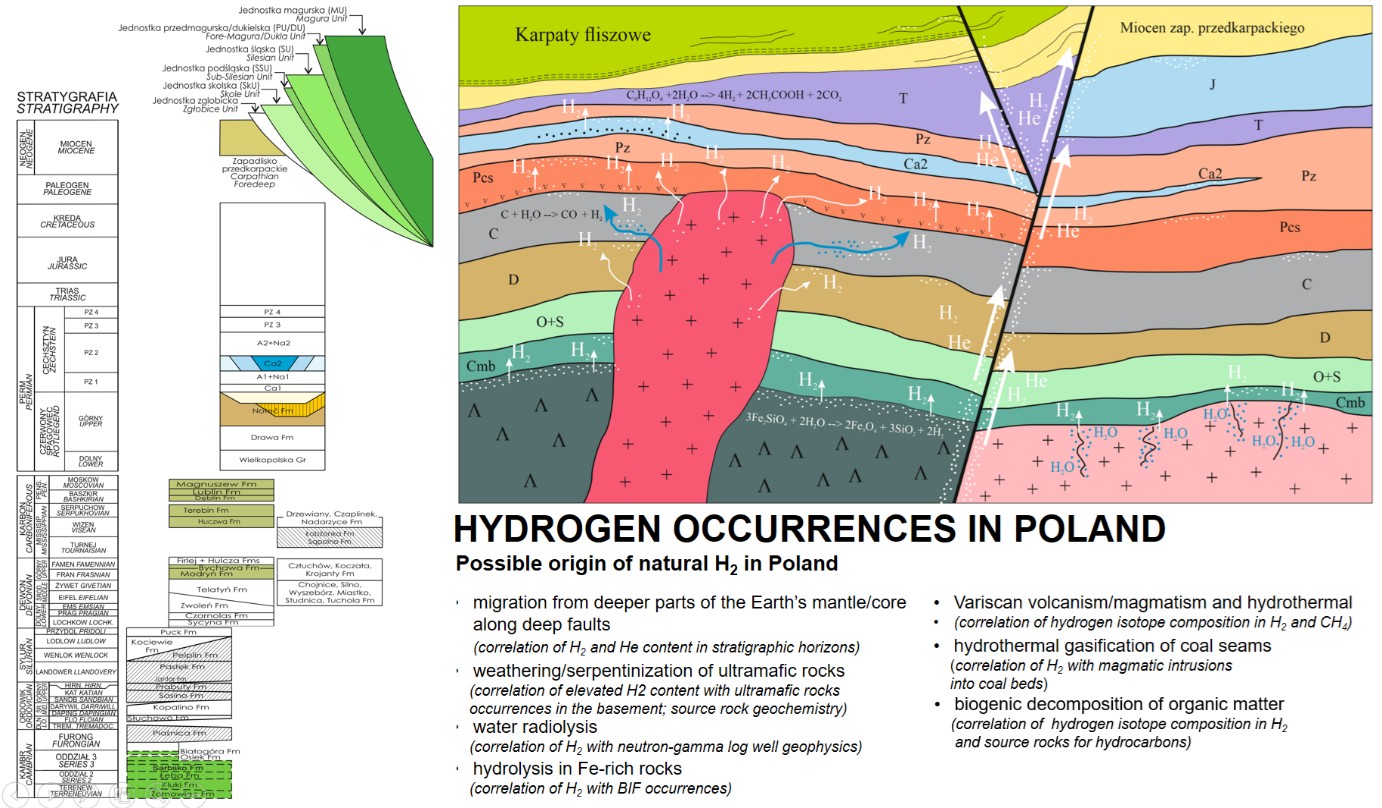
Natural hydrogen occurs in different stratigraphic and tectonic units and is therefore likely to have diverse origins. Dr Krystian Wójcik (PGI-NRI) has identified several major hydrogen systems that probably exist or have existed within the territory of Poland. These concepts will be tested by all consortium partners within the GEO-H2-PL project
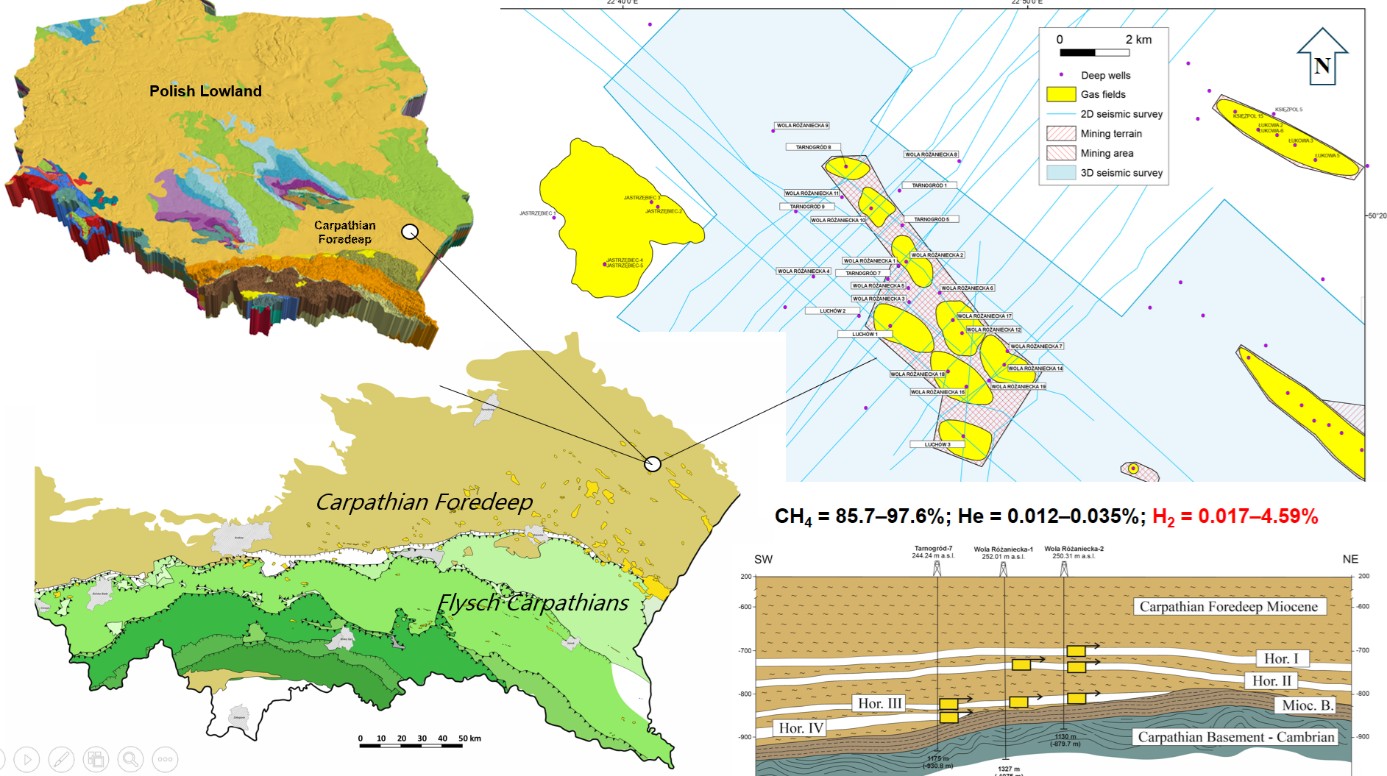
Hydrogen also occurs as an admixture in Polish natural gas fields, including the multi-horizon Tarnogród-Wola Różaniecka gas field within the Miocene of the Carpathian Foredeep. In some hydrocarbon accumulations, hydrogen concentrations reach several percent by volume. These occurrences will form an important part of the PGI-NRI research programme
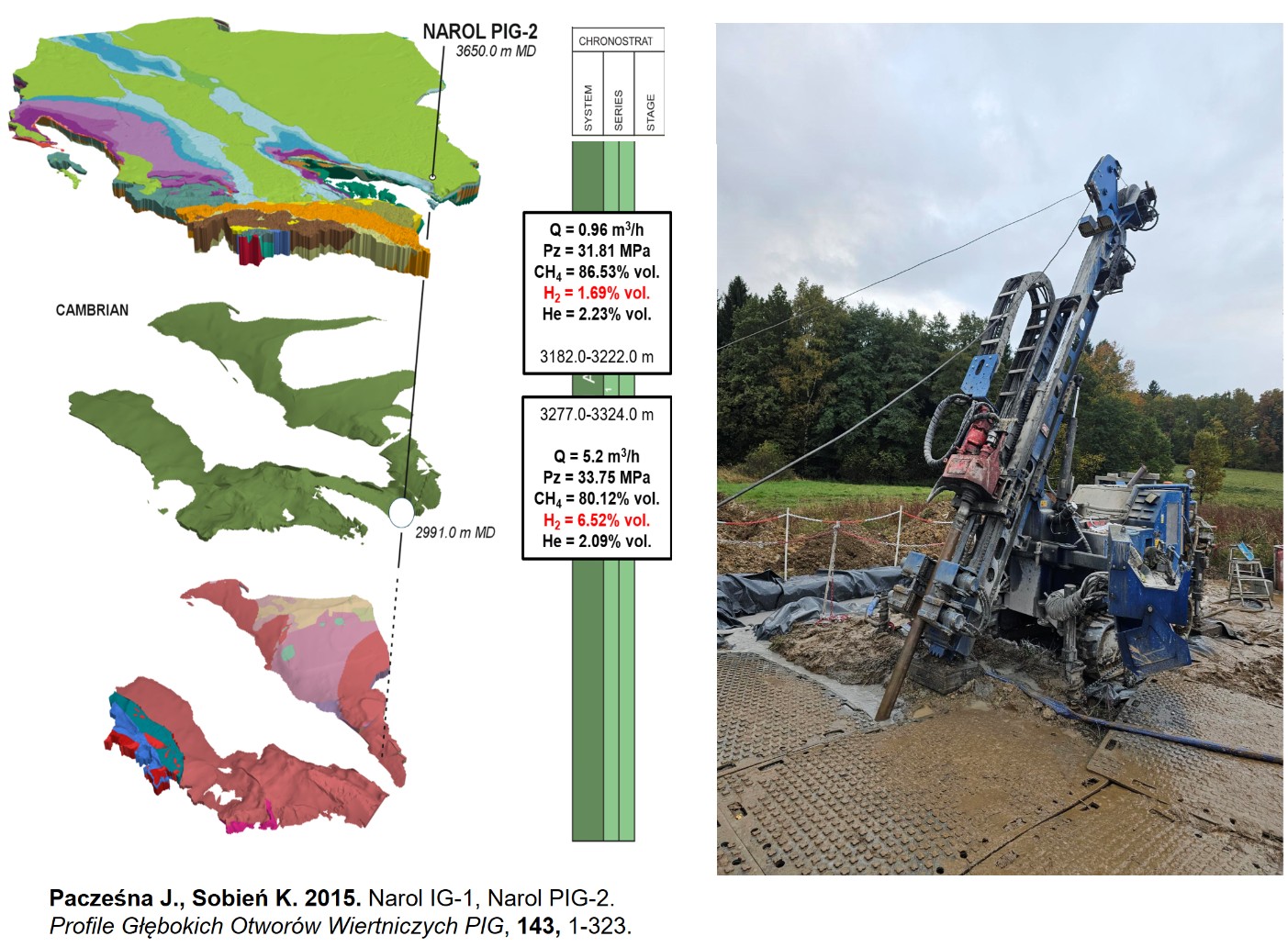
Experimental investigations aimed at identifying active and inactive deep hydrogen systems, followed by testing the most promising targets through drilling, represent the most demanding stage of GEO-H2-PL. PGI-NRI will carry out drilling operations, coring, geochemical analyses and geophysical surveys in the three most prospective areas representing different geological settings
Shaping Poland’s raw materials and energy policies
The experimental development phase undertaken by PIG-PIB will culminate in an evaluation of the significance of natural hydrogen for Poland’s national raw materials policy and in the preparation of recommendations concerning future regulatory frameworks and licensing systems governing hydrogen exploration and production. At present, natural hydrogen is not specifically addressed in the State Raw Materials Policy, Poland’s Energy Policy, or the Polish Hydrogen Strategy. Under the current provisions of the Geological and Mining Act, natural hydrogen exploration, and production activities are regulated under the same framework applicable to hydrocarbons. However, no formal threshold criteria currently exist for defining a natural hydrogen deposit or its boundaries. While solutions applied to natural gas and noble gases, particularly helium, may provide useful analogies for free hydrogen accumulations, no established Polish or international models yet exist for hydrogen dissolved in groundwater or brines.
During the final and most important phase of the project, PGI-NRI will carry out the principal objective of the GOSPOSTRATEG XIII programme: the preparation of a comprehensive roadmap for the exploration and production of natural hydrogen in Poland, accompanied by a development strategy and action plan at both national and regional levels. This roadmap will facilitate effective decision-making by government authorities and private-sector stakeholders participating in Poland’s emerging natural hydrogen market. Simultaneously, researchers from AGH and MEERI PAS will investigate public acceptance of natural hydrogen exploration and production activities and develop regional policy recommendations aligned with Poland’s Energy Policy to 2040.
Readers interested in natural hydrogen research in Poland are encouraged to consult the paper by Dr Krystian Wójcik, published in the November 2024 issue of Przegląd Geologiczny: https://www.pgi.gov.pl/dokumenty-pig-pib-all/publikacje-2/przeglad-geologiczny/2024/11-listopad-4/10693-wodor-naturalny-w-polsce/file.html
Project: GEO-H2-PL “A program for the exploration, recognition and development of natural hydrogen deposits for the purpose of shaping Poland's raw materials and energy policy”
Funding source: National Centre for Research and Development (NCBR), GOSPOSTRATEG XIII Strategic Programme for Scientific Research and Development Works
Agreement No.: GOSPOSTRATEG13/0002/2025
Date of agreement: 3 August 2026
Total funding: PLN 16,997,105.50
 PGI-NRI offer
 Mineral resources of Poland
  Oil and Gas in Poland


 Subscribe to RSS Feed