- Introduction
- About Project
- Current Activities
- History of Research in Poland
- World Projects
- Underground Laboratories
- Publications
- Links
- Contact
Introduction
The phenomenon of radioactivity has stirred great excitement ever since its discovery. As they reached successive milestones in nuclear physics, scientists have, over the decades, uncovered ever-new possibilities for its application - a journey that inevitably begins with the famous X-rays - gamma rays discovered by the father of radiation medicine, Roentgen. In later years, following the discovery of the ability of the nuclei of certain isotopes to undergo spontaneous radioactive decay - and later, the possibility of artificially fissioning them - an era of intensive research into the use of energy derived from these sources began. Nuclear energy and radiation medicine developed in the shadow of military programs. However, as the era of radium ointments and World War II came to an end and awareness of the need to prevent the effects of excessive radiation exposure began to take shape, it quickly became clear that radioactive waste must be properly secured.
It will soon be a century since the first prototype nuclear reactor was launched in Chicago. Today, more than four hundred such reactors are in operation worldwide for the sole purpose of energy production, and a number of small research reactors - including Poland’s MARIA reactor - serve the medical field by producing radiopharmaceuticals.
Over the years, as technology has advanced, public awareness has evolved, and with it, solutions for the safe handling of radioactive waste. Many discoveries in physics and chemistry still lie ahead, and some contemporary ideas - once considered science fiction straight out of Lem’s works - may become common solutions within the next few decades.
The early days of radioactive waste disposal, by any measure, are not a story to be proud of - from dumping barrels on the seabed to shipping them to Third World countries. Today, there are appropriate international regulations prohibiting such practices, and as concern for the environment and future generations has grown, new concepts have quickly emerged, the development of which continues to this day. Among these, underground storage at depths of several hundred meters holds a special place.
The waste designated for this type of repository consists of long-lived and highly radioactive materials. Most of the isotopes they contain decay over a time scale measured in geological terms - a timeframe that is difficult to comprehend within the average human lifespan. This process is accompanied by a very slow decline in radioactivity. Therefore, to reach an acceptable activity level comparable to natural radiation, this waste must “age” for thousands of years in complete isolation from the biosphere.
It should therefore come as no surprise that geologically based solutions are leading the way - nothing on our planet changes more slowly than the geological environment. Consequently, concepts for underground storage have been developing for many years, and their form and scope vary just as much as the types of waste and the waste management systems of individual countries. In countries where highly radioactive sources are a problem, the concept of borehole disposal is popular. In countries with a well-developed nuclear power industry, these are large-scale projects requiring tunneling, although in recent years the United States has developed the concept of so-called “very deep disposal” (several kilometers), based on borehole disposal but also designed specifically for the nuclear power industry - including spent nuclear fuel. The results of the initial analyses are looking promising.
Such projects are subject to extremely strict safety requirements, among which those relating to the location of the repository are of particular importance. The criterion most widely recognized by the general public is likely that of the stability of the massif and the storage - ranging from 10,000 to 1 million years. Over such a time span, it is necessary to demonstrate seismic and tectonic stability, isolation from water, and many, many other factors - while ensuring minimal impact on the potential site. Research into selecting such a site and subsequently characterizing one or two selected sites takes many years. Countries with the most advanced programs, such as Sweden, France, and Finland - which are just now beginning to build deep storage sites - began these efforts in the 1970s.
Conducting these analyses requires a series of studies specific to a given rock type or particular location; consequently, there are a number of underground laboratories around the world where multidisciplinary research is conducted on the stability of the formations in which they are located. These include clayey rocks, salt formations - salt domes and bedded salts - as well as crystalline rocks (mostly granitoids). Each rock group is characterized by a number of criteria - ranging from the degree of isolation from water, through low permeability of the rock itself or the surrounding rocks, to temperature resistance and mechanical stability. Research conducted in such laboratories aims to determine the parameters of the rock massif and further analyze them to ensure long-term stability.
Poland also has its own long-lived and high-level radioactive waste, originating from industry, medicine, and a research reactor. We are also facing the prospect of implementing nuclear energy, resulting, among other things, from the need to ensure a stable energy supply - and this is possible by utilizing various sources of energy. Therefore, we cannot avoid the issue of radioactive waste management. The PURL initiative - the Polish Underground Research Laboratory - is a joint effort by scientific and research institutions designed to address the needs of the national economy and sustainable development. Its goal is to continue and expand the research on deep geological disposal that began in Poland in the late 1990s, with the support and guidance of government agencies responsible for the safe management of radioactive waste. Conducting systematic and coordinated research is the foundation for future decisions, which can thus be made based on well-established knowledge.
About Project
The PURL Initiative - the Polish Underground Research Laboratory - is a joint effort by scientific and research institutions designed to address the needs of the national economy and sustainable development. Its goal is to continue and expand research on deep geological storage that began in Poland in the late 1990s, with the support and guidance of government agencies responsible for the safe management of radioactive waste. Conducting systematic and coordinated research is the foundation for future decisions, which can thus be made based on well-established knowledge.
The following participated in the project:
Polish Geological Institute - National Research Institute
Mineral and Energy Economy Research Institute
Polish Academy of Sciences
Insititute of Nuclear Chemistry and Technology
Institue of Silesia - Institute of Earth Sciences
Ministry of Economy of the Republic of Poland
Ministry of Climate and Environment - Chief National Geologist
National Atomic Energy Agency

Radioactive Waste Management Plant
Current Activities
Polish Nuclear Power Program (PPEJ) was approved.
On January 28, 2014, the Council of Ministers adopted the Polish Nuclear Power Program. This decision marks the culmination of a labor-intensive period of preparation and consultation on the Program, reaffirming the intention to implement nuclear power in Poland.
Among other things, the program includes guidelines for the management of radioactive waste and spent nuclear fuel. Attention to these issues in the nuclear industry is particularly important, as reflected in the provisions of the adopted document - awareness of and responsibility toward people and the environment will accompany the investment process from the very beginning.
This relates in particular to safety requirements concerning the storage of long-lived waste - including highly radioactive waste and spent nuclear fuel - not only from nuclear power plants, but also from research reactors, industry, and medicine.
According to the plan, research in this area will be conducted in a coordinated manner, as discussed in greater detail in the quoted passage:
“Following the adoption of the PPEJ Program, it is planned that the Ministry of Economy, the Polish Geological Institute, and other interested institutions will sign an agreement to support the concept of deep geological disposal of radioactive waste through the construction of the Underground Research Laboratory (PURL).
The purpose of the agreement is to:
-
Support scientific research aimed at improving deep geological storage techniques and identifying the geological conditions that ensure safe storage in deep geological formations, while also contributing to the development of the scientific workforce and technologies necessary to carry out future work.
-
To ensure the coordination of this work in Poland.
-
To make maximum use of international experience regarding the geological storage of radioactive waste.
-
To provide the public with objective information on geological storage.
-
Supporting the establishment of the Underground Research Laboratory (PURL).
-
Supporting the operations of the PURL, which is organizationally located within the Polish Geological Institute (PGI).
-
Utilizing the PURL’s experience and transforming it into an entity responsible for the preparation and construction of a deep geological storage facility.
The goals of PURL are:
- Coordinating work in Poland and compiling its results;
- International cooperation;Conducting scientific research;
- Expanding knowledge about the geology of potential storage sites;
- Promoting public awareness and transparency of activities;
- Preparing personnel and organizational structures for the operation of the storage site.
The research findings collected will be used in the future to identify a site and construct a deep geological repository for spent nuclear fuel and high-level radioactive waste.
The issue of spent nuclear fuel from research reactors was resolved in 2009 through agreements with the United States and the Russian Federation to export this fuel to the Russian Federation, as a supplier of fresh fuel. However, based on the experience of other countries, the need to build a spent nuclear fuel repository will arise approximately 30-40 years after the first nuclear power plant begins operation, which means no earlier than around 2050. Until then, spent nuclear fuel will be stored on the power plant premises, including in in-reactor storage pools. Although Poland has up to 50 years to commission such a repository (counting from the commercial commissioning of the first unit of the first nuclear power plant in 2024), the experience of other countries indicates the need to begin preparations well in advance. At this stage of the work, however, no options (including rock formations) for the construction of a spent nuclear fuel repository should be ruled out.”
We encourage those interested to read the entire document, which is available on the Ministry of Economy’s website:
EU regulations governing the deep storage of radioactive waste adopted in Poland
On November 5, 2013, the Polish government adopted a draft amendment to the Atomic Law, related, among other things, to the storage of radioactive waste (as reported by some media outlets: www.nettg.pl.)
The proposed amendment transposes into national law European Directive 2011/70/EURATOM of July 19, 2011, establishing a Community framework for the responsible and safe management of spent nuclear fuel and radioactive waste.
The directive clearly identifies underground repositories - that is, geological barriers - as the safest solution for the disposal of high-level radioactive waste and spent nuclear fuel. The explanatory statement to the project notes that, in light of plans to build nuclear power plants, this issue is becoming increasingly relevant in Poland, and work on such a repository should begin as soon as possible, as it will take many years to complete. This solution must also address highly radioactive waste from other sources within Poland’s economy.
The adoption of these legal regulations is yet another argument supporting the validity of the initiative and the implementation of the PURL project.
1st Conference of the PURL Underground Research Laboratory
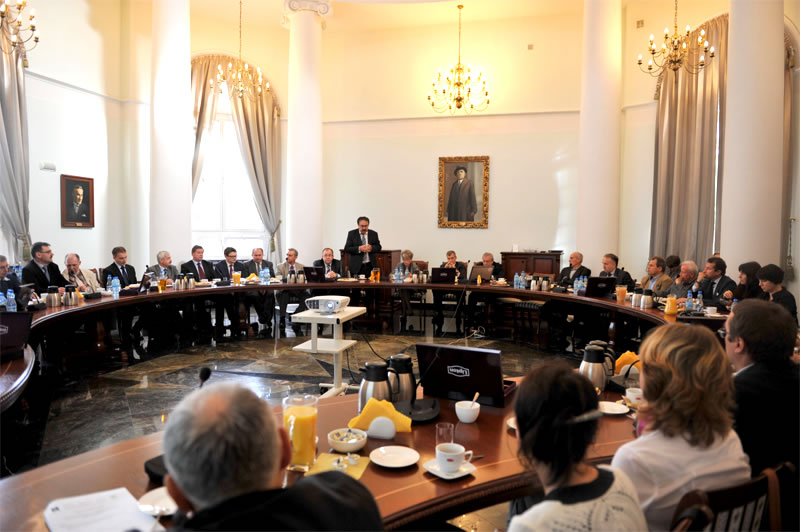
On October 28, 2013, a conference marking the launch of the PURL program was held at the headquarters of the Polish Geological Institute - National Research Institute (PGI) in Warsaw at 4 Rakowiecka Street.
The conference was opened by PGI-NRI Director Prof. Jerzy Nawrocki, who emphasized that the role of PGI-NRI is to coordinate and assist in organizing the work, and that the presented project is inter-institutional in nature.
The speech by the Government Plenipotentiary for Nuclear Energy, Deputy Minister of Economy Ms. Hanna Trojanowska, addressed the status of the Polish Nuclear Power Program and, as was clearly emphasized,the necessity of beginning preparatory work under the PURL project, even though the potential need for spent fuel storage may not arise until after 2050. Dr. Henryk Jacek Jezierski, Chair of the PURL Program Council, discussed the tasks and expectations for PURL.
During the discussion session:
Grzegorz Ryżyński, M.A., from PGI-NRI presented global experiences in the construction of deep repositories for radioactive waste and spent nuclear fuel, as well as in the operation of underground research laboratories, known as URLs,
and Dr. Leszek Lankof from the Mineral and Energy Economy Research Institute of the Polish Academy of Sciences presented Polish experiences and research related to the underground disposal of radioactive waste and spent nuclear fuel.
The conference concluded with a discussion led by Dr. Henryk Jacek Jezierski on cooperation in developing the concept for a Polish geological repository.
Approximately 40 people attended the conference.
Second Meeting of the Program Council of the PURL Underground Research Laboratory
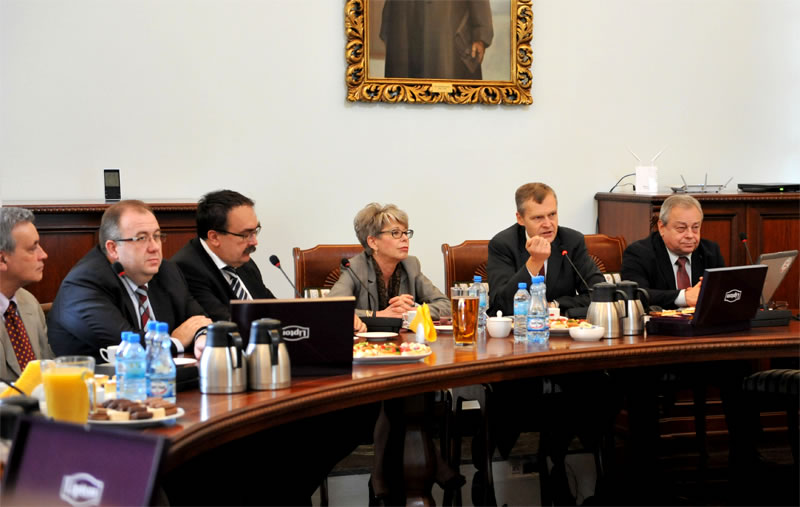
On October 28, 2013, at the headquarters of the Polish Geological Institute - National Research Institute (PGI-NRI) in Warsaw, located at 4 Rakowiecka Street, the second meeting of the Program Council of the PURL Underground Research Laboratory was held.
Following a presentation by Mr. Zbigniew Kubacki, Director of the Department of Nuclear Energy at the Ministry of Economy, on the current status of work on the strategic document “Polish Nuclear Power Program,” the Council discussed possible scenarios for the Program’s development and the role of issues related to geological disposal within it. PURL’s work should be aligned with the pace of implementation of the Polish Nuclear Power Program, particularly regarding the selection of appropriate public communication methods and the need for discussions on the safety of its implementation.
Based on the introductory material prepared by the Council Chair, the Council discussed the concept for the future operation of PURL. Noting the existence of far-reaching plans for the construction and operation of a repository and recognizing that a necessary preliminary step is the creation of a Polish URL - that is, a field research laboratory - the Council focused at this meeting on evaluating the actions taken (particularly the launch of the website and the organization of the first PURL conference).
As an immediate priority, the Council recommended:
- developing a detailed PURL action plan that outlines the direction of research efforts, such as establishing criteria for the siting of storages;
- Collecting proposals for research tasks related to geological storage (as the first stage in developing the program);
- increasing the participation of Polish researchers in international programs and considering the formation of a research consortium to enable applications for European funding.
The Chair announced the launch of the PURL website and asked Council members to submit information about their activities, organized meetings, etc., for publication on the PURL website. The website is intended to serve as a platform for exchanging information on geological storage.
First Meeting of the Program Council of the PURL Underground Research Laboratory
On May 20, 2013, the inaugural meeting of the Program Council of the PURL Underground Research Laboratory was held at the headquarters of the Polish Geological Institute - National Research Institute (PGI-NRI) in Warsaw, at 76 Jagiellońska Street.
The Director of PGI-NRI, Prof. Jerzy Nawrocki, Ph.D., welcomed the attendees and presented letters of appointment to the selected members of the Program Council. In accordance with Order No. 21 of the Director of PGI-NRI dated May 10, 2013, the Council consists of the following individuals:
- Prof. Andrzej Chmielewski, PhD, DSc, Eng.
- Andrzej Cholerzyński, MSc, Eng.
- Prof. Janusz Janeczek, PhD, DSc
- Henryk Jacek Jezierski, PhD
- Zbigniew Kubacki, MSc
- Prof. Eugeniusz Mokrzycki, PhD, DSc, Eng.
- Prof. Grzegorz Pieńkowski, PhD, DSc
- Janusz Włodarski, MSc, Eng.
Dr H. Jezierski was unanimously elected Chair of the Council, and Dr. hab. Grzegorz Pieńkowski, Associate Professor at PGI-NRI, was unanimously elected Secretary of the Council.
Dr H. Jezierski presented the concept of establishing the Polish Underground Research Laboratory (PURL). The purpose of establishing PURL is to address the issue of radioactive waste and to prepare for the construction of a repository for such waste.
History of Research in Poland
A research program for a deep geological repository had already been carried out in Poland. It was launched in connection with the construction of the Żarnowiec nuclear power plant in the 1980s, but was terminated when construction of the plant was suspended in 1990.
At that time, Central Research and Development Program (CPRB) No. 5.1.0, Objective No. 47, “Underground Repository for Radioactive Waste,” was established. As part of this program, the following studies were conducted:
1.Inwentaryzacja złóż soli formacji cechsztyńskiej mioceńskiej w wysadach solnych i w złożach pokładowych pod kątem ich przydatności dla składowania odpadów promieniotwórczych. Państwowy Instytut Geologiczny (PIG) 1988.
2.Kryteria przyrodnicze, technologiczne i ekonomiczno-społeczne wyboru lokalizacji podziemnego składowiska otworowo-ługowniczego w złożach soli kamiennej. - Chemkop, 1988.
3.Koncepcja podziemnego składowiska odpadów promieniotwórczych w wysadach solnych. Akademia Górniczo Hutnicza (AGH), 1988.
4.Studium struktur tektonicznych przy pomocy technik teledetekcyjnych i geofizycznych w rejonie wstępnie projektowanego podziemnego składowiska na odpady promieniotwórcze w pokładowym złożu soli kamiennej Mechelinki, woj. gdańskie. PIG, 1988.
5.Wstępne rozpoznanie stanu zaludnienia i zagospodarowania przestrzennego rejonu Mechelinki. Uniwersytet Adama Mickiewicza, Poznań 1988.
6.Studium wyboru lokalizacji i zakresu badań dla zaprojektowania budowy składowiska odpadów promieniotwórczych. Synteza studium. PIG, 1988.
7.Studium struktur tektonicznych przy pomocy technik teledetekcyjnych i geofizycznych w rejonie wstępnie projektowanych lokalizacji podziemnego składowiska w pokładowych złożach soli kamiennej. PIG, 1989.
8.Analiza materiałów geologicznych, geofizycznych, laboratoryjnych oraz analizy geochemiczne prób z wierceń archiwalnych na wysadzie Łanięta. AGH, 1989.
9.Analiza materiałów geologicznych, geofizycznych, laboratoryjnych i analizy geochemiczne prób z wierceń archiwalnych wykonanych na wysadzie Damasławek oraz opracowanie projektu głębokiego wiercenia do 1000 m. PIG, 1989.
10.Analiza i zestawienie wyników badań z uwzględnieniem obowiązujących kryteriów wyboru lokalizacji. PIG, 1989.
11.Informacja o pracach w zakresie wyboru obszarów i środowisk dla składowania odpadów promieniotwórczych w Polsce. PIG, 1989.
12.Studium struktur tektonicznych w otoczeniu wysadu solnego Damasławek przy pomocy technik teledetekcyjnych i geofizycznych. PIG, 1990.
In 1997, Poland signed the Joint Convention on the Safety of Spent Fuel Management and on the Safety of Radioactive Waste Management, which requires compliance with the fundamental safety principles set forth in documents developed by the International Atomic Energy Agency (IAEA) in Vienna.
Between 1997 and 1999, the Council of Ministers established the “Strategic Government Program (SPR) on Radioactive Waste and Spent Nuclear Fuel Management.” The President of the National Atomic Energy Agency (PAA) served as the supervisory body for the implementation of the SPR. The program’s objectives included drafting amendments to regulations, identifying potential repository sites, and developing an information policy. The SPR also included the task of “Selecting a site and developing a concept for a radioactive waste repository in deep geological formations.”
As part of the SPR, studies were conducted on deep geological storage, among other topics:
1.Opracowanie i zbadanie nowych sztucznych barier ochronnych, zapobiegających migracji najbardziej toksycznych radionuklidów ze składowiska odpadów promieniotwórczych. ICHiTJ, 1999.
2.Poszukiwania i charakterystyka materiałów naturalnych do budowy zewnętrznych barier składowiska odpadów promieniotwórczych. PIG, 1999.
3.Uzupełniające rozpoznanie wysadu solnego Damasławek. AGH, 1998.
4.Analiza wyników prac laboratoriów światowych dla głębokiego Składowiska Odpadów Promieniotwórczych pod kątem ich przydatności dla rozwiązań krajowych. Instytut Gospodarki Surowcami Mineralnymi i Energią (IGSMiE) PAN, 1998.
5.Analiza materiałów archiwalnych dotyczących struktur skalnych na Niżu Polskim pod kątem przydatności do lokalizacji głębokiego Składowiska Odpadów Promieniotwórczych. IGSMiE PAN, 1998.
6.Rozpoznanie budowy wewnętrznej czapy gipsowo-anhydrytowej wysadu solnego "Damasławek" płytkimi badaniami sejsmicznymi. PIG, 1999.
7.Ocena możliwości głębokiego składowania odpadów promieniotwórczych w skałach ilastych monokliny przedsudeckiej w rejonie Jarocina - Pogorzeli. IGSMiE PAN, 1999.
8.Opracowanie modelu koncepcyjnego krajowego głębokiego składowiska odpadów promieniotwórczych w skałach: a) solnych b) ilastych. IGSMiE PAN 1999.
9.Opracowanie projektu koncepcyjnego Podziemnego Laboratorium Badawczego (PLB) w wysadzie solnym Kłodawa. IGSMiE PAN, 1999.
As a result of SPR’s work, it was determined that the site selection process is lengthy and multi-stage, and is based on selection by elimination of available geological formations. The selection criteria were based on the assumptions that the geological structure should be characterized by:
- appropriate dimensions,
- a homogeneous and simple structure,
- impermeability ensuring no water flow,
- resistance to deformation,
- stability throughout geological history,
- and the absence of seismic activity.
As a result of the analysis, existing deep mines were eliminated as potential sites due to water-related hazards, reduced rock mass stability, de-fracturing resulting as a side effect of mining operations, proximity to other mines, and seismic activity. A preliminary analysis was conducted on 44 sites (17 metamorphic and igneous rocks, 7 clay formations, and 20 salt deposits).
The following were identified as promising:
- crystalline rocks of the East European Platform in northeastern Poland (considered reserve sites due to limited hydrogeological data),
- clayey rocks of the Pre-Sudeten Monocline near Jarocin - an Upper Triassic complex where geophysical surveys identified optimal locations,
- salt intrusions (selected): Damasławek, which has been surveyed in detail, and Kłodawa and Łanięta, identified based on an analysis of archival materials.
A study conducted in 2011 by the Mineral and Energy Economy Research Institute (Polish Academy of Sciences) „Przegląd, ocena i ustalenie możliwego zakresu wykorzystania opracowań (projektów, analiz, ekspertyz) w zakresie postępowania/gospodarowania odpadami promieniotwórczymi i wypalonym paliwem jądrowym” included:
1.Identification of the scope of studies conducted to date in Poland.
2.An assessment of the results of previous studies conducted, among other things, for the design and construction of the Żarnowiec Nuclear Power Plant, taking into account the conditions prevailing during the implementation period and the results of activities related to the siting and design of radioactive waste repositories: surface and deep.
3.A summary of previous comparative cost analyses, depending on the fuel cycle solution recommended for Poland.
4.A summary of previous comparative cost analyses of radioactive waste and spent fuel management, depending on the reactor technologies recommended for Poland.
5.Comparison of methods for managing spent nuclear fuel for the fuel cycle options recommended for Poland - including technical, technological, and cost analyses - to establish criteria that facilitate the decision to adopt an open or closed cycle.
6.Preparation of a balance sheet for radioactive waste and spent nuclear fuel for the individual phases of the fuel cycle.
The main focus of this analysis was on the quantitative and cost aspects of radioactive waste management, with less emphasis on technological considerations.
This study indicated that:
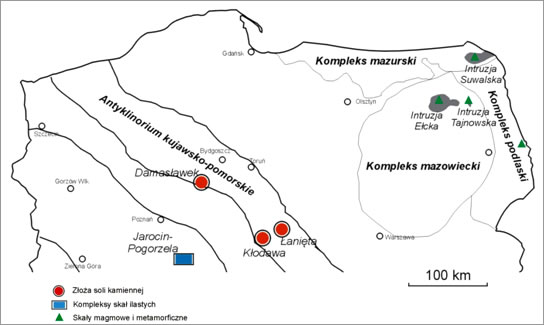
“Among the claystone formations found in Poland, the Upper Triassic claystone complex in the Pre-Sudeten monocline (near Jarocin and Pogorzela) was deemed the most promising; in this complex, the upper gypsum layers lie at depths ranging from 500 to 1,000 m below ground level. The promising area, from the perspective of locating an underground waste repository with an area of approximately 20 km², is situated about 10 km southwest of Jarocin.
Within the salt structures, the salt intrusions of the Central Poland region - Damasławek, Łanięta, and the southern part of Kłodawa - were deemed the most favorable for the location of a deep storage. Locations in the northeastern part of Poland within crystalline rock massifs were considered backup options.„
Locations of rock formations identified for the construction of deep repositories for spent nuclear fuel and high-level radioactive waste. According to Mineral and Energy Economy Research Institute (Polish Academy of Sciences).
The work carried out by the Mineral and Energy Economy Research Institute (Polish Academy of Sciences) in Kraków, coordinated by J. Ślizowski, K. Ślizowski, and L. Lankof, focused primarily on the potential use of salt formations as a host rock for radioactive waste disposal. Within this research program, laboratory investigations were conducted on Zuber salts and clayey salt rocks, which constitute the principal components of the Zechstein salt diapirs in the Central Poland salt province. The investigations included:
1.Mineralogical and petrographic studies, including chemical analyses of Zuber salts, scanning electron microscopy (SEM), investigations of the mechanisms and rates of desiccation crack formation, and determination of moisture loss during thermal drying of Zuber salts.
2.Physical property testing, including measurements of porosity, density, permeability, and gas content.
3.Geomechanical testing, including strength, creep, and stress relaxation measurements.
4.Sorption studies of Zuber salts.
Based on these investigations, it was concluded that only part of these salt formations (specifically the brown Zuber salts) could be considered suitable for waste disposal.
One of the principal findings of these studies was that the investigated rocks exhibited a high capacity for radionuclide sorption, representing a significant advantage for repository applications.
The same research institute also investigated the suitability of clay formations as potential host rocks. The Keuper claystone-mudstone complex of the Fore-Sudetic Monocline was identified as a promising formation, and two candidate areas were selected: Jarocin and the area between Kępno and Wieruszów. In both locations, a homogeneous clay-rich sequence more than 200 m thick was identified at depths of approximately 450 - 500 m below ground level, overlain by a 300 m thick sandstone unit.
In the Jarocin - Pogorzela area, the Mineral and Energy Economy Research Institute (Polish Academy of Sciences) conducted additional investigations, including:
development of a database of geological and hydrogeological boreholes;geophysical surveys to refine the understanding of local tectonics and hydrogeological conditions;development of a hydrogeological model;assessment of environmental conditions, spatial planning constraints, and the socio-economic setting;preparation of a detailed geological investigation programme, including drilling activities;preparation of an application for a licence to conduct detailed geological investigations.
Despite these investigations, the authors themselves acknowledged that the existing level of site characterization in the Jarocin-Pogorzela area was clearly insufficient to support a decision on the construction of a deep geological repository.
For the Damasławek salt diapir, supplementary laboratory analyses of preserved salt samples were carried out, together with new geophysical investigations (geoelectrical, gravimetric, and shallow seismic surveys).
Two prospective areas suitable for the location of shafts and underground repository excavations were identified within the central part of the diapir.
Because of the significant differences in the physical and chemical properties of the selected host rock types, two conceptual models of a deep geological repository were developed: one for a clay-rock formation and another for a salt diapir. Both concepts considered the disposal of either spent nuclear fuel or vitrified high-level radioactive waste.
The proposed underground research laboratory (URL) in the Kłodawa rock salt mine may be regarded as the beginning of the Polish URL programme. The planned research was intended to focus on thermo-hydro-mechanical (THM) processes, excluding radiological and chemical effects. However, due to public opposition, the project was never implemented.
This text is an adapted extract from a study by Dr. H. J. Jezierski titled “Concept for the Construction of a Deep Geological Repository for Radioactive Waste in Poland,” commissioned by the Department of Nuclear Energy of the Ministry of Economy, which holds the copyright to this text.
World Projects
The concept of deep geological repositories for radioactive waste originated in the 1950s, when the U.S. National Academy of Sciences proposed the underground disposal of radioactive waste generated by the military nuclear programme.
Research efforts subsequently led to the establishment of the U.S. Department of Energy's Waste Isolation Pilot Plant (WIPP) by the U.S. Congress in 1979. WIPP, located in New Mexico at a depth of approximately 650 m within Permian bedded salt formations, was developed as the first deep geological repository in the United States. Construction activities began in 1988 but were interrupted several times due to public opposition. The facility finally commenced waste acceptance in 1999. It should be noted that WIPP was designed specifically for the disposal of transuranic waste generated by the U.S. nuclear weapons programme.
The disposal of spent nuclear fuel at WIPP would require changes to U.S. legislation. In the United States, spent nuclear fuel and high-level radioactive waste were stored at 121 locations across the country. Based on data collected over a ten-year period, the U.S. Department of Energy identified ten candidate repository sites in six states in 1984. Following preliminary investigations, President Ronald Reagan approved three sites for detailed characterization: Hanford (Washington), Deaf Smith County (Texas), and Yucca Mountain (Nevada), located within a former nuclear weapons testing area. The U.S. Department of Energy initiated extensive investigations at Yucca Mountain to determine whether the geological formation could safely accommodate more than 70,000 tonnes of spent nuclear fuel for long-term disposal. The proposed repository host rock consisted of volcanic tuffs, a lithology that is generally uncommon for deep geological disposal because of its less favourable properties compared with other potential host rocks. Consequently, the site selection was influenced by factors beyond lithology alone.
In 1987, the U.S. Congress amended the Nuclear Waste Policy Act, authorizing detailed investigations exclusively at Yucca Mountain. In 2002, President George W. Bush approved the development of the repository. The U.S. Department of Energy had originally planned for the Yucca Mountain Repository (YMR) to begin accepting spent nuclear fuel in 1998; however, this target was not achieved. The delays resulted, among other factors, from public opposition, which influenced political decisions leading to reductions in the funding required for repository development.
During his 2008 presidential campaign, Barack Obama pledged to terminate the Yucca Mountain project. Following his election, funding for the programme was effectively discontinued by Congress. Nevertheless, many experts and policymakers in the United States continue to advocate for the continuation of the Yucca Mountain Repository. The U.S. experience demonstrates how easily deep geological repository projects can become highly politicized.
In contrast, the ONKALO repository in Finland has progressed without comparable political obstacles. The repository, intended for the disposal of spent nuclear fuel from Finnish nuclear power plants, is being developed by Posiva Oy, jointly owned by Fortum Oyj and Teollisuuden Voima Oyj (TVO), the operators of Finland's nuclear power plants. The Finnish Parliament ratified the Decision in Principle in 2001, formally approving the Olkiluoto site - adjacent to one of Finland's nuclear power plants - as the location for the repository. This decision was preceded by the construction of the ONKALO underground rock characterization facility.
According to the Finnish repository concept, spent nuclear fuel is encapsulated in corrosion-resistant disposal canisters and emplaced at a depth of several hundred metres. The annular space between the disposal canisters and the host rock is filled with highly compacted bentonite clay, which acts as an engineered barrier. According to information published by the Finnish Radiation and Nuclear Safety Authority (STUK), the development of the repository comprises five principal phases: pre-decision research and site investigations (1978 - 2001), repository design and construction of the underground rock characterization facility (2001 - 2014), repository construction (2014 - 2020), repository operation (2020 - 2120), and repository closure (2120 - 2125).
Sweden has also undertaken the development of a deep geological repository for spent nuclear fuel generated by its commercial nuclear reactors. In the early 1980s, Svensk Kärnbränslehantering AB (SKB) was established as the organization responsible for implementing Sweden's radioactive waste management programme. The proposed repository design is based on copper-coated disposal canisters containing spent fuel assemblies emplaced in deposition holes excavated in crystalline granite bedrock. The remaining void space is filled with bentonite clay, whose very low hydraulic conductivity and high swelling capacity provide an effective barrier to groundwater movement. In 2009, it was announced that the Swedish repository would be constructed near the Forsmark Nuclear Power Plant. At that time, completion of construction was provisionally anticipated around 2015. Although the project has experienced delays, repository implementation has continued through the licensing and construction phases.
This text is an adapted extract from a study by Dr. H. J. Jezierski titled “Concept for the Construction of a Deep Geological Repository for Radioactive Waste in Poland,” commissioned by the Department of Nuclear Energy of the Ministry of Economy, which holds the copyright to this text.
Underground Laboratories
The process of constructing deep geological repositories should be distinguished from the facilities known as Underground Research Laboratories (URLs).
URLs have been established in most countries intending to build deep repositories for radioactive waste. Among the main tasks carried out by URLs are: determining the impact of waste emplacement on the environment, improving radioactive waste repository construction techniques, promoting knowledge about disposal, modelling geological barriers, verifying the correctness of engineering designs, investigating the effects of the Excavation Disturbed Zone (EDZ) resulting from mining works, etc.
It is expected that a URL should provide:
- minimal and acceptable seismic hazard,
- limitation of waste contact with the biosphere over a period of thousands of years (through low rock permeability and the absence of groundwater or its very slow migration, as well as radionuclide sorption capacity).
The growing interest in radioactive waste disposal has contributed to the construction of underground laboratories and the implementation of national and international research projects.
Currently, there are 13 operating URLs worldwide, including 6 located in crystalline rocks, 4 in clay complexes, 2 in rock salt, and 1 in tuffs.
For several years, there has been a tendency toward cooperation between countries producing relatively small amounts of radioactive waste in order to construct a common regional radioactive waste repository. Currently, the SAPIERR (Support Action: Pilot Initiative for European Regional Repositories) programme, involving 21 organizations from 14 countries, is funded by the European Union.
Germany has experience in the construction of radioactive waste repositories. The Morsleben Repository for Radioactive Waste (Endlager für radioaktive Abfälle Morsleben - ERAM) is located in deep geological layers within the Bartensleben rock salt mine in Saxony-Anhalt. After salt mining operations ceased, the Bartensleben mine was designated by the government as a radioactive waste repository. Today, the facility is operated by Deutsche Gesellschaft zum Bau und Betrieb von Endlagern für Abfallstoffe mbH under the supervision of the Bundesamt für Strahlenschutz.
Salt mining in this region has a tradition of more than one hundred years. The first shaft, "Marie", was sunk in 1897. The "Bartensleben" mine began operation between 1910 and 1912. The mine is between 320 and 630 m deep. The initial enthusiasm regarding the construction of repositories in salt has, however, begun to decline with the emergence of new methods for investigating the stability of such repositories, due to the plasticity of salt. This property of salt, until recently regarded as an advantage, is now increasingly perceived in safety analyses as a hazard.
The French experience in radioactive waste disposal is also worth discussing. ANDRA, the French public organization responsible for managing the radioactive waste disposal process, has developed a methodology for repository construction. In developing this methodology, research carried out at the Meuse/Haute-Marne URL was used, where the Agency is preparing for repository operation in a clay formation.
The ANDRA methodology includes the following stages:
- Identification of constraints and evaluation of appropriate solutions based on waste properties and geological conditions.
- Identification of potential repository locations in deep geological formations.
- Communication and relations with stakeholders as part of the decision-making process at national, regional, and local levels.
- Geological investigations, simulation programmes, and modelling.
- Construction and operation of the underground URL.
- Technological development programmes.
- Safety studies and preparation of applications for nuclear safety and radiological protection licences.
- Construction of the repository.
- Definition of the waste acceptance criteria package, disposal specifications, and inspection rules.
- Detailed studies concerning operating conditions, reversibility, long-term monitoring, etc.
- Cost assessment for the facility.
The schedule for implementation of the repository programme in France included:
- 1991 - adoption of the Waste Act, which established ANDRA, with responsibilities including research for the geological disposal of high- and intermediate-level radioactive waste.
- 1994 - 1996 - geological field investigations in Meuse and Haute-Marne in clay formations at a depth of 500 m below ground level. 1999 - repository construction licence.
- 2005 - report summarizing geological investigations.
- 2006 - second legislative approval of the geological repository (further legislative amendments were planned for 2016).
- 2009 - selection of the detailed site (30 km² out of the 250 km² investigated).
- 2010 - 2012 - geological investigations.
- 2013 - 2014 - public debate leading to government site selection.
- 2015 - licence to commence repository operation.
- 2017 - start of construction.
- 2025 - start of waste disposal.
The example of France shows how often legal regulations have been adapted to the needs of the project and how important public communication is during the implementation of such a project.
It should also be remembered that in France URLs are operated by two institutions: ANDRA and, separately, IRSN.
Under geological conditions similar to those in France, repository research is also being carried out in Belgium. The experience gained from the underground laboratory in Mol (Belgium) in clay formations over many years has confirmed the technological feasibility of disposal under such geological conditions. These studies demonstrated the advantages of these cohesive formations as disposal media. At the same time, because of the poor bearing properties of clay formations, they highlighted the need to pay particular attention to engineering solutions ensuring excavation stability.
It can be observed that, depending on geological conditions, countries conduct investigations in the most likely repository host formations available within their own geology. Thus, URLs have been established in Pinawa and Lac du Bonnet (Canada), Äspö HRL (Sweden), and Grimsel GTS (Switzerland) in crystalline rocks; in claystones at Mol (HADES) in Belgium and Bure URL in France; in salt at Asse Salt Mine, Gorleben (Germany), and Carlsbad, New Mexico (WIPP, USA); and in the previously discussed tuffs at Yucca Mountain (USA).
Outside Europe and the USA, Japan is at the forefront of URL research. The Horonobe Research Centre conducts research and development on the geological disposal of high-level radioactive waste and engineering research to verify the reliability of deep geological disposal under actual geological conditions.
The Horonobe Underground Research Laboratory (HURL) is a project of the Japan Atomic Energy Agency (JAEA) in northern Hokkaido and aims to investigate the geological environment in sedimentary rocks. HURL is one of the underground research laboratories planned under the Long-Term Programme for Research, Development and Utilization of Nuclear Energy (LTP). The role of underground research laboratories is defined in the LTP as providing facilities for research and development to confirm waste disposal technologies under geological conditions and to establish methods for safety assessment. The URL is also intended to serve as a demonstration facility for the public to improve understanding of the principles of geological disposal.
Operation of HURL is planned for a period of 20 years in three phases:
- Phase 1: Preliminary surface investigations (6 years).
- Phase 2: Underground access investigations (6 years).
- Phase 3: Investigations using the completed facility (9 - 11 years).
The results of research at HURL contribute to the development of the geological disposal programme and the preparation of safety regulations by the government. They are intended to be considered together with the results from subsequent Japanese URLs operated by JAEA (Tono Geoscience Center in Gifu Prefecture and Tokai Research and Development Center in Ibaraki Prefecture), together with the results of extensive international cooperation. An important element attracting attention because of future repository operational safety is research on the Excavation Disturbed Zone (EDZ) resulting from mining activities. Such investigations are carried out at many URLs. For example, at the Canadian URL at Lac du Bonnet, in areas of high in situ stress, damaged zones were found to extend several tens of centimetres, and maintaining excavation stability required sealing water inflows.
At Mont Terri in Switzerland, investigations in clay formations showed that clay minerals exhibiting plastic and swelling properties caused rapid healing of fractures formed within the EDZ. Similar investigations have been carried out in rock salt. Such studies make it possible not only to assess the depth of the EDZ in different rock types but are also used to select the best repository location and to minimize risks during repository operation. Another issue important for long-term repository safety investigated in URLs is the effect of heat generated by radioactive waste on the surrounding rock. Experimental studies have shown that heat generation significantly accelerates creep in rock salt, while in clay formations and fractured crystalline rocks it may cause significant movement of water and gases within the rock mass and alter the nature of fractures.
Research at URLs has also been directed towards evaluating the behaviour of bentonite buffer materials and repository backfill. In rocks other than crystalline rocks - that is, less consolidated formations - it has been established that a key issue is ensuring protection of excavations against rockfalls, collapse, creep, and convergence. In sedimentary formations, URLs have investigated the hazard of increased lateral groundwater migration resulting from the depositional and formation processes of these rocks. Studies concerning disposal in salt show that excavations in salt do not require additional support, but the issue of rock mobility remains. On the one hand, convergence processes have a positive aspect because they lead to complete (tight) isolation of the disposed waste, but on the other hand they may create safety problems due to the unpredictability of salt behaviour.
This text is an adapted extract from a study by Dr. H. J. Jezierski titled “Concept for the Construction of a Deep Geological Repository for Radioactive Waste in Poland,” commissioned by the Department of Nuclear Energy of the Ministry of Economy, which holds the copyright to this text.
Publications
Polish Publications
- Analiza i badania bezpieczeństwa radiologicznego KSOP Różan dla etapu ostatecznego zamknięcia – monitoring wybranych elementów środowiska w otoczeniu składowiska. PIG, Warszawa 1999
- Analiza i badania bezpieczeństwa radiologicznego KSOP Różan dla etapu ostatecznego zamknięcia – charakterystyka składowiska i odpadów promieniotwórczych znajdujących się na jego terenie. IEA, Świerk 1997
- Analiza i zestawienie wyników badań z uwzględnieniem obowiązujących kryteriów wyboru lokalizacji. Zakład Geologii Gospodarczej PIG, Warszawa 1989
- Analiza materiałów archiwalnych dotyczących struktur skalnych na Niżu Polskim pod kątem przydatności do lokalizacji głębokiego Składowiska Odpadów Promieniotwórczych (SOP). CPPGSMiE PAN, Kraków 1998
- Analiza materiałów geologicznych, geofizycznych, laboratoryjnych oraz analizy geochemiczne prób z wierceń archiwalnych na wysadzie Łanięta. Międzyresortowy Instytut Fizyki i Techniki Jądrowej AGH, Kraków 1989
- Analiza materiałów geologicznych, geofizycznych, laboratoryjnych i analizy geochemiczne prób z wierceń archiwalnych wykonanych na wysadzie Damasławek oraz opracowanie projektu głębokiego wiercenia do 1000 m. Zakład Geologii Złóż Surowców Chemicznych PIG, Warszawa 1989
- Analiza wariantowa bilansów, unieszkodliwiania i składowania odpadów promieniotwórczych oraz wypalonego paliwa z reaktorów jądrowych nowej generacji (w przypadku podjęcia programu jądrowego w Polsce) w latach 2010-2100. Etap I, II. IEA, Świerk 1999
- Analiza wyników prac laboratoriów światowych dla głębokiego Składowiska Odpadów Promieniotwórczych pod kątem ich przydatności dla rozwiązań krajowych. CPPGSMiE PAN, Kraków 1998
- Badanie wypalonego paliwa jądrowego pochodzącego z polskich reaktorów badawczych Ewa i Maria i zgromadzonego w basenach przechowawczych w Świerku. IEA, Świerk 1999
- Budowa instalacji wyparnej do zatężania i oczyszczania ciekłych odpadów promieniotwórczych. ICHTJ, Warszawa 1999
- Informacja o pracach w zakresie wyboru obszarów i środowisk dla składowania odpadów promieniotwórczych w Polsce. PIG, Warszawa 1989
- Inwentaryzacja złóż soli formacji cechsztyńskiej mioceńskiej w wysadach solnych i w złożach pokładowych pod kątem ich przydatności dla składowania. odpadów promieniotwórczych. PIG 1988
- Dudała J., Ochojski A., Przewłocki K., Ślizowski K., 2005: Badania właściwości sorpcyjnych iłowców solnych wieku cechsztyńskiego przy pomocy izotopów promieniotwórczych 90Sr + 90Y i 152, 154Eu. “Technika jądrowa w przemyśle, medycynie, rolnictwie i ochronie środowiska” 07-09.09 2005 AGH Kraków, Wyd. Wydział Fizyki I Informatyki Stosowanej AGH, s. 40-45
- Janeczek J., 1998: Stan badań nad lokalizacją głębokiego składowiska odpadów promieniotwórczych w Polsce. Bezpieczeństwo Jądrowe i Ochrona Radiologiczna (Biuletyn Informacyjny Państwowej Agencji Atomistyki) vol. 35, nr 3, 36-45
- Janeczek J., Włodarski J., 2000: Wytypowanie lokalizacji i opracowanie koncepcji składowiska odpadów promieniotwórczych w głębokich formacjach geologicznych. Bezpieczeństwo Jądrowe i Ochrona Radiologiczna (Biuletyn Informacyjny Państwowej Agencji Atomistyki) vol. 41, nr.1, 29-48
- Janeczek J., Włodarski J., 2001: The Polish concept of radioactive waste disposal. W: Geological Challenges in Radioactive Waste Isolation. Third Worldwide Review (P.A. Witherspoon, G.S. Bodvarsson, eds.), Ernest Orlando Lawrence Berkeley National Laboratory, University of California, pp.205-208
- Jezierski H.J., 2009: Złoża soli – wspaniała historia i nowe wyzwania. Mente et Malleo Głównego Geologa Kraju . Przegląd Geologiczny tom 57, nr 9 (2009)
- Koncepcja podziemnego składowiska odpadów promieniotwórczych w wysadach solnych. Międzyresortowy Instytut Fizyki i Techniki Jądrowej AGH, Kraków 1988
- Kryteria przyrodnicze, technologiczne i ekonomiczno-społeczne wyboru lokalizacji podziemnego składowiska otworowo-ługowniczego w złożach soli kamiennej. Ośrodek Badawczo-Rozwojowy Górnictwa Surowców Chemicznych – Chemkop, Kraków 1988
- Lankof L., 2010: Analiza odkształcalności i utraty masy zubrów brunatnych w aspekcie składowania odpadów promieniotwórczych w środkowopolskich wysadach solnych. Studia Rozprawy Monografie 166. IGSMiE PAN 2010. ISBN 978-83-60195-93-2
- Ney R. i in., 1999: Ocena możliwości głębokiego składowania odpadów promieniotwórczych w skałach ilastych monokliny przedsudeckiej w rejonie Jarocina – Pogorzeli. Arch, IGSMiE PAN. Kraków 1999
- Ocena możliwości głębokiego składowania odpadów promieniotwórczych w skałach ilastych monokliny przedsudeckiej w rejonie Jarocina – Pogorzeli. IGSMiE PAN, Kraków 1999
- Ocena możliwości magazynowania substancji w złożach soli kamiennej, na zlecenie Ministerstwa Środowiska 2006.IGSMiE PAN
- Ocena stanu zaludnienia i zagospodarowania przestrzennego rejonu wysadu solnego Damasławek. Studium Urbanistyki, Architektury i Planowania Przestrzennego TWP, Poznań 1990
- Opracowanie i zbadanie nowych sztucznych barier ochronnych, zapobiegających migracji najbardziej toksycznych radionuklidów ze składowiska odpadów promieniotwórczych. ICHTJ, Warszawa 1999
- Opracowanie modelu koncepcyjnego krajowego głębokiego składowiska odpadów promieniotwórczych w skałach: a) solnych b) ilastych. IGSMiE PAN, Kraków 1999
- Opracowanie projektu koncepcyjnego Podziemnego Laboratorium Badawczego (PLB) w wysadzie solnym Kłodawa. IGSMiE PAN, Kraków 1999
- Opracowanie zbioru aktów prawnych i dokumentów zgodnych z aktualnym prawodawstwem w Polsce, konwencjami międzynarodowymi i przepisami obowiązującymi w Unii Europejskiej dotyczącymi gospodarki odpadami promieniotwórczymi i wypalonym paliwem jądrowym Etap I, II, III. Science and Engineering International Sp. z o.o., Warszawa 1999
- Opracowanie zgodnego ze standardami europejskimi systemu organizacyjnego gospodarki odpadami promieniotwórczymi w Polsce. ATOMENERGOSERVICE Sp. z o.o., Warszawa 1998
- Paszcza H., Margis A., 2009: Polityka państwa w zakresie bezpieczeństwa energetycznego kraju w aspekcie wykorzystania z3ó? solnych jako magazynów paliw i bezpiecznych składowisk Przegląd Geologiczny tom 57, nr 9 (2009)
- Poborska-Młynarska K., Ślizowski K., 1999: Zasady lokalizacji głębokiego składowiska odpadów promieniotwórczych (SOP) w wysadowych złożach solnych w Polsce. Przemysł wydobywczy – teraźniejszość i przyszłość. Wyd. Wydział Górniczy AGH, SITG AGH, Kraków
- Postępowanie z wypalonym paliwem jądrowym z polskich reaktorów badawczych – praca realizowana w kooperacji z British Nuclear Fuel, PLC i Framatome. IEA, Świerk 1997
- Poszukiwania i charakterystyka materiałów naturalnych do budowy zewnętrznych barier składowiska odpadów promieniotwórczych. PIG, Warszawa 1999
- Ślizowski J. i in., 2011: Przegląd, ocena i ustalenie możliwego zakresu wykorzystania opracowań (projektów, analiz, ekspertyz) w zakresie postępowania/gospodarowania odpadami promieniotwórczymi i wypalonym paliwem jądrowym. IGSMiE PAN opr. archiwalne dla MG
- Rozpoznanie budowy wewnętrznej czapy gipsowo-anhydrytowej wysadu solnego "Damasławek" płytkimi badaniami sejsmicznymi. PIG, Warszawa 1999
- Ślizowski J., Lankof L., 2000: Conceptual model of an underground radioactive waste repository in rock-salt and clay formations in Poland. Wyd. IGSMiE, T. 16, z. 4, Kraków
- Ślizowski J., Lankof L., 2003: Salt-mudstones and rock salt suitabilities for radioactive-waste storage systems: rheological properties. Applied Energy. Vol. 75 Nos. 1-2, Elsevier
- Ślizowski J., Ślizowski K., Lankof L., 2006: Porównanie parametrów wytrzymałościowych i reologicznych iłowców solnych i soli kamiennej w aspekcie składowania odpadów promieniotwórczych wydzielających ciepło. Przegląd górniczy, 4/2006. Wyd. SITG Katowice, s.72-76
- Ślizowski K i in., 1999: Opracowanie projektu koncepcyjnego Podziemnego Laboratorium Badawczego (PLB) w wysadzie solnym Kłodawa, Arch, IGSMiE PAN. Kraków 1999
- Ślizowski K., 2006: Możliwości zagospodarowania podziemnych złóż i struktur solnych w Polsce na składowisko odpadów promieniotwórczych. Przegląd Geologiczny, vol. 54, nr 4. Wyd. PIG Warszawa s. 314
- Ślizowski K. i in., 2005: Badania laboratoryjne zubrów (iłowców solnych) dla oceny możliwości składowania odpadów promieniotwórczych w polskich wysadach solnych, IGSMiE PAN – Gospodarka Surowcami Mineralnymi, s. 1-107
- Przewłocki K., Ślizowski K., 2004: Składowanie wysokoaktywnych odpadów promieniotwórczych w formacjach geologicznych. Gospodarka Surowcami Mineralnymi t. 20, z. 1, Kraków
- Ślizowski K., 2000: Opracowanie modelu koncepcyjnego dla głębokiego składowiska odpadów promieniotwórczych w skałach solnych i ilastych na obszarze Polski. PAN – Działalność Naukowa nr 9, W-wa
- Ślizowski K., 2001: Zasady magazynowania ciekłych odpadów w głębokich strukturach przepuszczalnych Technika Poszukiwań Geologicznych Geosynoptyka i Geotermia nr 6/2001
- Ślizowski K., 2002: Hydrogeologiczne i górnicze kryteria składowania ciekłych odpadów niebezpiecznych w głębokich strukturach przepuszczalnych. Technika Poszukiwań Geologicznych Geosynoptyka i Geotermia nr 1
- Ślizowski K., Janeczek J., Przewłocki K., 2003: Suitability of salt-mudstones as a host rock in the salt domes for radioactive waste storage. Applied Energy. Vol. 75 Nos. 1-2, Elsevier
- Ślizowski K., Köhsling J., Lankof L., 2004: Uwarunkowania podziemnego składowania odpadów niebezpiecznych w Polsce. Studia Rozprawy Monografie. Wyd. IGSMiE-PAN, Kraków
- Ślizowski K., Lankof L., 2009: Geologiczne uwarunkowania składowania wysokoaktywnych odpadów promieniotwórczych w złożach soli w Polsce. Przegląd Geologiczny tom 57, nr 9 (2009) s. 829-838
- Ślizowski K., Przewłocki K., Włodarski J., 2003: Perspectives of the deep storage of long living radioactive waste in rock structures on the territory of Poland. Polityka Energetyczna tom 6 zeszyt specjalny. Wyd IGSM Kraków
- Ślizowski K., Ślizowski J., Lankof L., 2001: Badania laboratoryjne zubrów dla wstępnej oceny ich przydatności do budowy podziemnego składowiska odpadów promieniotwórczych. Działalność Naukowa PAN, 12/2001
- Ślizowski K., Ślizowski J., Lankof L., 2006: Investigating salt claystones properties for assessing potential radioactive waste storage in Polish salt diapirs. Polish Academy of Sciences, Annual Report. Wyd. Publishing Department Office of Analyses, Scientific Information and Publications, Warszawa, s. 93-95. Gilewicz-Wolter
- Ślizowski K., Janeczek J., Przewłocki K., 2003: Suitability of salt-mudstones as a host rock In salt domes for radioactive-waste storage. Applied Energy 75, 119-128
- Studium Programowo-Przestrzenne ostatecznego zamknięcia Krajowego Składowiska Odpadów Promieniotwórczych w Różanie. IEA, Świerk 1999
- Studium Programowo-Przestrzenne Powierzchniowego Składowiska Odpadów Promieniotwórczych Nisko i Średnioaktywnych – część ogólna, rozwiązania techniczne i założenia branżowe do oszacowania nakładów inwestycyjnych. PROCHEM, Warszawa 1999
- Studium przestrzennego zagospodarowania i zaludnienia województwa gdańskiego na wschód od Żarnowca – rej. Opalino-Głuszewo. Instytut Geografii Społeczno-Ekonomicznej I Planowania Przestrzennego WAM, Poznań 1989
- Studium struktur tektonicznych przy pomocy technik teledetekcyjnych i geofizycznych w rejonie wstępnie projektowanego podziemnego składowiska na odpady promieniotwórcze w pokładowym złożu soli kamiennej Mechelinki, woj. gdańskie. PIG, Warszawa 1988
- Studium struktur tektonicznych przy pomocy technik teledetekcyjnych i geofizycznych w rejonie wstępnie projektowanych lokalizacji podziemnego składowiska w pokładowych złożach soli kamiennej. PIG, Warszawa 1989
- Studium struktur tektonicznych w otoczeniu wysadu solnego Damasławek przy pomocy technik teledetekcyjnych i geofizycznych. PIG, Warszawa 1990
- Studium wyboru lokalizacji i zakresu badań dla zaprojektowania budowy składowiska odpadów promieniotwórczych. Synteza studium. PIG, Warszawa 1988
- Unieszkodliwianie odpadów wysokoaktywnych przy pomocy źródeł akceleratorowych. Projekt badawczy KBN, WFiTJ AGH, Kraków 1999
- Uraninite and UO2 in spent nuclear fuel: a comparison Janusz Janeczek i inni Journal of Nuclear Materiale Vol.238 1996
- Uzupełniające rozpoznanie wysadu solnego Damasławek. Etap I, II, WGGiOŚ AGH, Kraków 1998
- Uzupełniające studium regionalne złóż surowców skalnych – masywy skał magmowych i wielkie kompleksy skał ilastych. PIG, Warszawa 1998
- Wstępne rozpoznanie stanu zaludnienia i zagospodarowania przestrzennego rejonu Mechelinki. Instytut Geografii Społeczno-Ekonomicznej i Przestrzennego Zagospodarowania UAM, Poznań 1988
- Wytypowanie lokalizacji i opracowanie materiałów wyjściowych do Koncepcji Programowo-Przestrzennej nowego składowiska odpadów promieniotwórczych (SOP) nisko i średnioaktywnych. Etap I, II, III. PIG, Warszawa 1999
- Zbadanie własności oraz dobór materiałów zestalających i izolujących pod kątem ich wykorzystania do budowy sztucznych barier ochronnych (projekt wiodący pakietu). IAE, Świerk 1999
- Kleczek Z., Zeljaś D., 2004: Lokalizacja podziemnego składowiska odpadów promieniotwórczych. Prz.Geol., nr 8/1: 649-652
- Przewłocki K., Ślizowski K., 2004: Składowanie wysokoaktywnych odpadów promieniotwórczych w formacjach geologicznych. Gospodarka Surowcami Mineralnymi, 20, 1: 39-64
- Analiza wybranych formacji jury dolnej pod kątem ich przydatności do składowania odpadów promieniotwórczych. PIG-PIB. Warszawa, 2012. Opracowanie archiwalne, temat nr: 61.3403.1101.00.0, kierownik tematu: Paweł Brański
- Brański P., 2007: Ocena możliwości wykorzystania niektórych przedkenozoicznych kopalin ilastych w Polsce dla celów ochrony środowiska. Przegląd Geologiczny, 55, 467-474
- Brański P., 2010: Geneza osadów ilastych formacji ciechocińskiej (jura dolna, toark) w południowej Polsce a ich znaczenie gospodarcze. Biul. Państw. Inst. Geol., 439, 2: 249-258
- Ślizowski K. i in., 2011: Prognoza zmian w zakresie postępowania/gospodarowania odpadami promieniotwórczymi i nie będących nimi substancjami promieniotwórczymi w Polsce. IGSMiE PAN opr. archiwalne dla MG
International Publications
- Alexander W.R, McKinley Deep geological disposal of radioactive waste. Radioactivity in the environment. Vol 9
- Costs of Reprocessing Versus Directly Disposing of Spent Nuclear Fuel before the Committee on Energy and Natural Resources United States Senate November 14, 2007
- DYREKTYWA RADY 2011/70/EURATOM z dnia 19 lipca 2011 r. ustanawiająca ramy wspólnotowe w zakresie odpowiedzialnego i bezpiecznego gospodarowania wypalonym paliwem jądrowym i odpadami promieniotwórczymi
- IAEA 2006 — Geological disposal of radioactive waste.Safety Standards No WS-R-4
- IAEA 2007 — Strategy and Methodology for Radioactive Waste Characterization. TECDOC-1537
- Makhnach A., Petrova N., Kutyrlo V., Vysotsky E. Problems and prospects for construction of radioactive waste disposal sites in Belarus Przegląd Geologiczny tom 57, nr 9 (2009)
- Reversibility and Retrievability in Geologic Disposal of Radioactive Waste Reflections at the International Level NUCLEAR ENERGY AGENCY ORGANISATION FOR ECONOMIC CO-OPERATION AND DEVELOPMENT 2010
- Transportation and Storage Subcommittee Report to the Full Commission Updated Report Blue Ribbon Commission on America’s Nuclear Future Washington, DC January 2012
- Boisson J.-Y. (ed.), 2005 – Clay Club Catalogue of Characteristics of Argillaceous Rocks. NUCLEAR ENERGY AGENCY No. 4436
- Chapman N.A., 2006 – Geological Disposal of Radioactive Wastes – Concept, Status and Trends. Journal of Iberian Geology, 32 (1): 7-14
- Claret F., Bauer A., Schaefer, Griffault L., Lanson B., 2002 – Experimental investigation in the interaction of clays with high-pH solutions: a case study from the Callovo– Oxfordian formation, Meuse-Haute Marne underground laboratory (France). Clays and Clay Minerals, 50, 632–645
- Claret F., Sakharov B.A., Drits V.A., Velde B., Meunier A., Griffault L., Lanson B., 2004 – Clay minerals in the Meuse-Haute Marne underground laboratory (France): Possible influence of organic matter on clay mineral evolution. Clays and Clay Minerals, 52: 515-532
- Cuadros J., 2008 – Clay as sealing material in nuclear waste repositories. Geology Today, 24, (3): 99-103
- Delage P., Cui Y.J., Tang A.M., 2010 – Clays in radioactive waste disposal. Journal of Rock Mechanics and Geotechnical Engineering 2 (2): 111–123
- Delay J., Rebours H., Vinsot A., Robin P., 2007 – Scientific investigation in deep wells for nuclear waste disposal studies at the Meuse/Haute Marne underground research laboratory, Northeastern France. Physics and Chemistry of the Earth, 32: 42–57
- Deniau I., Devol-Brown I., Derenne S., Behar F., Largeau C., 2008 – Comparison of the bulk geochemical features and thermal reactivity of kerogens from Mol (Boom Clay), Bure (Callovo–Oxfordian argillite) and Tournemire (Toarcian shales) underground research laboratories. Science of the Total Environment, 389: 475-485
- Gaucher E., Robelin C., Matray J.M., Negrel G., Gros Y., Heitz J.F., et al., 2004 – Andra underground research laboratory: interpretation of the mineralogical and geochemical data acquired in the Callovian–Oxfordian formation by investigative drilling. Physics and Chemistry of the Earth, Parts A/B/C. Water Geochem. Hydrogeol., 29: 55–77
- Mazurek M., 1999 – Mineralogy of the Opalinus Clay. In: M. Thury, P. Bossart (eds.): Mont Terri Rock Laboratory. Results of the Hydrogeological, Geochemical and Geotechnical Ex¬periments Performed in 1996 and 1997. Geological Report, 23: 15-18. Swiss National Hydrological and Geological Sur¬vey, Bern
- Mazurek M., Pearson F.J., Volckaert G., Bock H., 2003 – Features, Events and Processes Evaluation Catalogue for Argillaceous Media. NUCLEAR ENERGY AGENCY No. 4437
- Nuclear Waste Disposal in Germany – Investigation and evaluation of regions with potentially suitable host rock formations for a geologic nuclear repository, 2007. BGR, Hannover/Berlin, April 2007
- Ramirez S., Vieillard P., Bouchet A., Cassagnabere A., Meunier A., Jacquot E., 2005 – Alteration of the Callovo–Oxfordian clay from Meuse-Haute Marne underground laboratory (France) by alkaline solution. I. A XRD and CEC study. Applied Geochemistry, 20: 89–99
- Tinseau E., Bartier D., Hassouta L., Devol-Brown I., Stammopse D., 2006 – Mineralogical characterization of the Tournemire argillite after in situ interaction with concretes. Waste Manage. 26, 7: 789–800
- Thury M., 2002 – The characteristics of Opalinus Clay investigated in the Mont Terri underground rock laboratory in Switzerland. C. R. Physique, 3: 923-933
- Thury M., Bossart P., 1999 – The Mont Terri Rock Laboratory, a new international research project in a Mesozoic shale formation, in Switzerland. Engineering Geology, 52: 347-359
- Turrero M.J., Fernández A.M., Pena J., Sánchez M.D., Wersin P., Bossart P., Sánchez M., Melón A., Garralón A., Yllera A., Gómez P., Hernán P., 2006 – Pore water chemistry of a Paleogene continental mudrock in Spain and a Jurassic marine mudrock in Switzerland: Sampling methods and geochemical interpretation. Journal of Iberian Geology 32 (2) 2006: 233-258
- Van Keer I., De Craen M., 2001 – Sedimentology and diagenetic evolution of the Boom Clay: state of the art. SCK-CEN report R-3483, Mol, Belgium
- Verstricht J., Blümling P., Merceron T., 2003 – Repository concepts for nuclear waste disposal in clay formations. In: Fields Neasurements in Geomechanics. Proc. of the 6th Int. Symp. Oslo (Norway) 15-18 September 2003
- Vieillard P., Ramirez S., Bouchet A., Cassagnabere A., Meunier A., Jacquot E., 2004 – Alteration of the Callovo-Oxfordian clay from Meuse-Haute Marne Underground Laboratory (France) by alkaline solution: II. Modelling of mineral reactions. Applied Geochemistry, 19: 1699–1709
- Aranyossy J.F. (ed.), 2007 – Clay in natural and engineered barriers for radioactive waste cofinement. Physics and Chemistry of the Earth, 32(1-7): 1-538
- Landais P., Aranyossy J.F. (eds), 2004 – Clays in natural and engineered barriers for radioactive waste confinement. Papers from ANDRA Meeting, Reims, France, 2002. Applied Clay Science, 26(1-4): 1-542
- Potter P.E, Maynard, J,B., Depetris, P.J., 2005 – Mud and Mudstones. Springer, Berlin, 289 pp. ISBN 3-540-22157-3
- Safety Case for the Disposal of Spent Nuclear Fuel at Olkiluoto – Models and Data for the Repository System 2012 Part 2. Posiva Report 2013-1
- Safety Case for the Disposal of Spent Nuclear Fuel at Olkiluoto – Models and Data for the Repository System 2012 Part 1. Posiva Report 2013-1
- Yu L., Rogiers B., Gedeon M., Marivoet J., De Craen M., Mallants D., 2013 – A critical review of laboratory and in-situ hydraulic conductivity measurements for the Boom Clay in Belgium. Applied Clay Science, 75-76, p. 1-12
- Dupuis M-C., Gonnot F-M.,2013 – The Cigeo project: Meuse/Haute-Marne reversible geological disposal facility for radioactive waste. ANDRA Publication
- Aparicio L. (ed.), 2013 – Making nuclear waste governable – Deep underground disposal and the challenge of reversibility. ANDRA Publication
- Bollingerfehr W., Filbert W., Herold P., Lerch C., Müller-Hoeppe N., Charlier F., Kilger R., 2013 – Technical Design and Optimization of a HLW-Repository in the Gorleben Salt Dome including Detailed Design of the Sealing System. WM2013 Conference, February 24 -28, 2013, Phoenix, Arizona, USA
- Mönig J., Beuth T., Wolf J., Lommerzheim A., Mrugalla S., 2013 – Preliminary Safety Analysis of the Gorleben Site: Safety Concept and Application to Scenario Development Based on a Site-Specific Features, Events and Processes (Fep) Database – 13304. WM2013 Conference, February 24 -28, 2013, Phoenix, Arizona, USA
- The Safety Case and Safety Assessment for the Disposal of Radioactive Waste, 2012. IAEA Safety Standards Series SSG-23
- Saari J., 2012 – Seismic Activity Parametres of the Olkiluoto Site. Posiva Report 2012-34
- Safety Case for the Disposal of Spent Nuclear Fuel at Olkiluoto -Surface and Near-Surface Hydrological Modelling in the Biosphere Assessment BSA-2012. Posiva Report 2012-30
- Fox A., Forchhammer K., Pettersson A., La Pointe P., Lim, D-H., 2012 – Geological Discrete Fracture Network Model for the Olkiluoto Site, Eurajoki, Finland. Posiva Report 2012-27
- Pimenoff N., Venäläinen A., Järvinen H., 2012 – Climate And Sea Level Scenarios For Olkiluoto For The Next 10,000. Posiva Report 2012-26
- McEwen T.(ed.), Aro S., Kosunen P., Mattila J., Pere T., Käpyaho A., Hellä P., 2012 – Rock Suitability Classification – RSC 2012. Posiva Report 2012-24
- Pere T.(ed.), Mattila J., Aro S., Ahokas H., Vaittinen T., 2012 – Layout Determining Features, their Influence Zones and Respect Distances at the Olkiluoto Site. Posiva Report 2012-21
- Poteri A., Nordman H., Pulkkanen V-M., Hautojärvi A., Kekäläinen, P., 2012 – Representing Solute Transport Through the Multi-Barrier Disposal System by Simplified Concepts. Posiva Report 2012-20
- Sievänen U., Karvonen T., Dixon D., Hansen J., Jalonen T., 2012 – Design, Production and Initial State of the Underground Disposal Facility Closure. Posiva Report 2012-19
- Safety Case for the Disposal of Spent Nuclear Fuel at Olkiluoto – Synthesis 2012. Posiva Report 2012-12
- Safety Case for the Disposal of Spent Nuclear Fuel at Olkiluoto – Biosphere Assessment 2012. Posiva Report 2012-10
- Safety Case for the Disposal of Spent Nuclear Fuel at Olkiluoto – Assessment of Radionuclide Release Scenarios for the Repository System 2012. Posiva Report 2012-9
- Safety Case for the Disposal of Spent Nuclear Fuel at Olkiluoto – Formulation of Radionuclide Release Scenarios 2012. Posiva Report 2012-8
- Safety Case for the Disposal of Spent Nuclear Fuel at Olkiluoto – Features, Events and Processes 2012. Posiva Report 2012-7
- Safety Case for the Disposal of Spent Nuclear Fuel at Olkiluoto – Complementary Considerations 2012. Posiva Report 2012-11
- Safety Case for the Disposal of Spent Nuclear Fuel at Olkiluoto – Description of the Disposal System 2012. Posiva Report 2012-5
- Safety Case for the Disposal of Spent Nuclear Fuel at Olkiluoto – Performance Assessment 2012. Posiva Report 2012-4
- Safety Case for the Disposal of Spent Nuclear Fuel at Olkiluoto – Design Basis 2012. Posiva Report 2012-3
- Kuva J.(ed.), Myllys M., Timonen J., Kelokaski M., Ikonen J., Siitari-Kauppi M., Lindberg A., Aaltonen I., 2012 – Microstructure, Porosity and Mineralogy Around Fractures in Olkiluoto Bedrock. Posiva Report 2012-2
- Monitoring at Olkiluoto – a Programme for the Period Before Repository Operation. Posiva Report 2012-1
- Äspö Hard Rock Laboratory Annual Report 2011. SKB TR-12-03
- KBS-3H Complementary studies, 2008-2010. SKB TR-12-01
- Areias L., Verstricht J., Fischer T., Philipp J., 2012 – Seismic Monitoring at the Underground Nuclear Research Laboratory in MOL, Belgium. WM2012 Conference Proceedings (on CD), Phoenix, AZ, United States, 26 February – 1 March 2012 / American Nuclear Society (ANS), Phoenix, AZ, United States, American Nuclear Society, 2012, p. 1-12
- Breen B.J., Garcia-Sineriz J.L., Maurer H., Mayer S., Schröder T.J., Verstricht J., 2012 – EC MoDeRn Project: In-situ Demonstration of Innovative Monitoring Technologies for Geological Disposal. WM2012 Conference Proceedings (on CD), Phoenix, AZ, United States, 26 February – 1 March 2012 / American Nuclear Society, Phoenix, AZ, United States, American Nuclear Society, 2012, p. 1-15
- Garitte B., Sillen X., Li Xiang Ling, Armand G., Vaunat J., Gens A., 2012 -Comparative study of three in-situ heating tests in anisotropic media: the HE-D, TER and ATLAS experiments. Impact of thermo-hydro-mechanical chemical (THMC) processes on the safety of underground radioactive waste repositories. Proceedings of the European Commission TIMODAZ-THERESA International Conference, Luxembourg, 29 September – 1 October 2009, Luxembourg, Luxembourg, 29 September – 1 October 2009 / European Commission, Brussels, Belgium, European Commission, 2012, p. 159-171
- Van Iseghem P., 2012 – Corrosion issues of radioactive waste packages in geological disposal systems. Nuclear corrosion science and engineering, Woodhead Publishing, p. 939-987
- Marivoet J., Weetjens E., 2012 – An Assessment of the Impact of Advanced Nuclear Fuel Cycles on Geological Disposal. Radioactive Waste, s.l., Intechopen.com, p. 487-502
- Li Xiang Ling, Bastiaens W., Weetjens E., Sillen X., 2012 – The THM boundary conditions control in the design of the large scale in situ PRACLAY heater test. Impact of thermo-hydro-mechanical chemical (THMC) processes on the safety of underground radioactive waste repositories. Proceedings of the European Commission TIMODAZ-THERESA International Conference, Luxembourg, 29 September – 1 October 2009, Luxembourg, Luxembourg, 29 September – 1 October 2009 / European Commission, Brussels, Belgium, European Commission, p. 385-390
- Bollingerfehr W., Lerch C., Filbert W., Zhang Q., 2012 – Thermal-Mechanical Model Analysis used for Evaluating a Repository Concept for Heat-Generating Radioactive Waste in Salt-Rock. Mechanical Behavior of Salt. SaltMech7 Conference
- IAEA 2011 – Disposal of Radioactive Waste Specific Safety Requirements. IAEA Safety Standards Series SSR-5
- IAEA 2011 – The Management System for the Development of Disposal Facilities for Radioactive Waste. IAEA Nuclear Energy Series NW-T-1.2
- IAEA 2011 – Viability of Sharing Facilities for the Disposal of Spent Fuel and Nuclear Waste. IAEA TECDOC 1658
- IAEA 2011 – Geological Disposal Facilities for Radioactive Waste. IAEA Safety Standards Specific Safety Guide No. SSG-14, Vienna 2011
- Pimenoff N., Venäläinen A., Järvinen H., 2011 – Climate scenarios for Olkiluoto on a Time-Scale of 120,000 Years. Posiva Report 2011-4
- Pulkkanen V-M., Nordman H., 2011 – Effects of Bedrock Fractures on Radionuclide Transport near a Vertical Deposition Hole for Spent Nuclear Fuel. Posiva Report 2011-3
- SKB 2011 – Long-term safety for the final repository for spent nuclear fuel at Forsmark Main report of the SR-Site project Volume I-III. SKB TR-11-01
- SKB 2011 – Äspö Hard Rock Laboratory. Annual report 2010. SKB TR-11-10
- SKB 2011 – Long-term safety for the final repository for spent nuclear fuel at Forsmark. Main report of the SR-Site project. Updated 2012-12. SKB TR-11-01
- SKB 2011 – Long-term safety for the final repository for spent nuclear fuel at Forsmark. Main report of the SR-Site project. SKB TR-11-01
- Beerten K., 2011 – Effects of global warming on the geosphere and hydrosphere for deep geological disposal, Mol-Dessel nuclear zone, Belgium. External Report of the Belgian Nuclear Research Centre; ER-143; CCHO 2009-0940000), ISSN 1782-2335
- Chen G., Sillen X., Verstricht J., Li Xiang Ling, 2011 – ATLAS III in situ heating test in boom clay: Field data, observation and interpretation. Computers and Geotechnics, 38:5(2011), p. 683-696, ISSN 0266-352X
- De Cannière P., Kursten B., Druyts F., Moors H., Gens R., 2011 – Sulphur-related issues in deep underground nuclear waste disposal systems. Sulphur-assisted corrosion in nuclear disposal systems, Leeds, United Kingdom, Maney Publishing, p. 165-169
- Yu L., Weetjens E., Perko J., Mallants D., 2011 – Comparison of Numerical Tools Through Thermo-Hydro-Gas Transport Modeling for a Geological Repository in Boom Clay. 2009 TOUGH2 Symposium , Berkeley, CA, United States, 14-16 September 2009.- In: Nuclear Technology, 174:3(2011), p. 411-423, ISSN 0029-5450
- Van Geet M., De Craen M., Beerten K., Leterme B., Mallants D., Wouters L., Cool W., Brassinnes S., 2011 – Climate evolution in the long-term safety assessment of surface and geological disposal facilities for radioactive waste in Belgium. Geologica Belgica, 15:1-2(2011), p. 8-15, ISSN 1374-8505
- IAEA 2010 – Technological Implications of International Safeguards for Geological Disposal of Spent Fuel and Radioactive Waste. IAEA Nuclear Energy Series No. NW-T-1.21
- NEA-OECD 2010 – Geoscientific Information in the Radioactive Waste Management Safety Case. OECD Publications Service
- SKB 2010 – RD&D Programme for research, development and demonstration of methods for the management and disposal of nuclear waste. SKB TR-10-63
- Cuss R. J., Harringtong J. F., Noy D. J., 2010 – Large scale gas injection test (Lasgit) performed at the Äspö Hard Rock Laboratory. Summary report 2008. SKB TR-10-38
- Neretnieks Ivars, Liu Longcheng, Moreno Luis, 2010 – Mass transfer between waste canister and water seeping in rock fractures. Revisiting the Q-equivalent model. SKB TR-10-42
- Dueck A., 2010 – Thermo-mechanical cementation effects in bentonite investigated by unconfined compression tests. SKB TR-10-41
- Winberg A. (editor), 2010 – Fault Rock Zones Characterisation – Final report. TRUE-1 Continuation Project. SKB TR-10-36
- Hökmark H., Lönnqvist M., Fälth B., 2010 – THM-issues in repository rock. Thermal, mechanical, thermo-mechanical and hydro-mechanical evolution of the rock at the Forsmark and Laxemar sites. Updated 2011-10. SKB TR-10-23
- Hallbeck L., 2010 – Principal organic materials in a repository for spent nuclear fuel. Updated 2010-10. SKB TR-10-19
- SKB 2010 – Design, construction and initial state of the underground openings. Updated 2013-01. SKB TR-10-18
- SKB 2010 – Spent nuclear fuel for disposal in the KBS-3 repository. Updated 2011-12. SKB TR-10-13
- SKB 2010 – Design and production of the KBS-3 repository. SKB TR-10-12
- Åkesson M., Kristensson O., Börgesson L., Dueck A., Hernelind J., 2010 – THM modelling of buffer, backfill and other system components. Critical processes and scenarios. SKB TR-10-11
- Weetjens E., Marivoet J., Seetharam S., 2010 – Performance indicators Quantifying the Contribution of Safety Functions to the Confinement of Radionuclides in a Geological Repository System. Scientific Basis for Nuclear Waste Management XXXIV. Symposium Proceedings, San Fransisco, United States, 5-9 April 2010 / MRS, Warrendale, PA, United States, Materials Research Society, 2010, p. 191-196
- Wang L., Jacques D., De Cannière P., 2010 – Effects of an alkaline plume on the Boom Clay as a potential host formation for geological disposal of radioactive waste. (External Report of the Belgian Nuclear Research Centre; ER-28; CCHO 2000-773/00/00), ISSN 1782-2335
- Verstricht J., Areias L., Bastiaens W., Li Xiang Ling, 2010 – Measurement techniques for in situ stresses around underground constructions in a deep clay formation. Proceedings 14th International Conference on Experimental Mechanics (ICEM 14), Poitiers, FRANCE, July 4-9, France, 4-9 July 2010 / EuraSEM, Poitiers, France, EDP Sciences, 2010, p. 1-8
- Van Iseghem P., Marivoet J., 2010 – Safety Assessment of Geological Disposal of High-Level Radioactive Waste in Boom Clay: Relation with the Radionuclide Inventory Proceedings of the 12th International Conference on Environmental Remediation and Radioactive Waste Management, Liverpool, United Kingdom, 11-15 October 2009 / ASME (American Society of Mechanical Engineers), IME (Institution of Mechanical engineers) and NI (Nuclear Institute) , Fairfield, NJ, United States, ASME, p. 1-6
- Martens E., Maes N., Weetjens E., Van Gompel M., Van Ravestyn L., 2010 – Modelling of a Large-scale In-situ Migration Experiment with 14C-labelled Natural Organic Matter in Boom Clay. Radiochimica Acta, 98:9-11(2010), p. 695-701, ISSN 0033-8230
- Marivoet J., Weetjens E., Raeymaekers F., Seetharam S., 2010 – Testing Safety and Performance Indicators for a Geological Repository in Clay. External Report of the Belgian Nuclear Research Centre; ER-125; EC 6th Framework, Pamina WP3.4, ISSN 1782-2335
- Li Xiang Ling, Bastiaens W., Van Marcke P., Verstricht J., Chen G., Weetjens E., Sillen X., 2010 – Design and development of large-scale in-situ PRACLAY heater test and horizontal high-level radioactive waste disposal gallery seal test in Belgian HADES. Journal of Rock Mechanics and Geotechnical Engineering, 2:2, p. 103-110, ISSN 1674-7755
- Pöhler M., Jobmann M., 2010 – Reference disposal concept for a final repository for HLW in a clay formation in Germany. DBE TECHNOLOGY GmbH, Peine, Germany
- IAEA 2009 – Geological Disposal of Radioactive Waste: Technological Implications for Retrievability Geological Disposal of Radioactive Waste: Technological Implications for Retrievability. IAEA Nuclear Energy Series No. NW-T-1.19
- IAEA 2009 – Safety Assessment for Facilities and Activities. Safety Standards Series № GSR, Part 4
- Sundberg J., Back Pär-Erik, Ländell M., Sundberg A., 2009 – Modelling of temperature in deep boreholes and evaluation of geothermal heat flow at Forsmark and Laxemar. Updated 2010-09. SKB TR-09-14
- SKB 2009 – Äspö Hard Rock Laboratory. Annual report 2008. SKB TR-09-10
- SKB 2009 – Site description of Laxemar at completion of the site investigation phase. SDM-Site Laxemar. SKB TR-09-01
- Charlier R., Chambon R., Li Xiang Ling, Dizier A., Sieffert Y., Collin F., Levasseur S., 2009 – TIMODAZ – Modelling the Excavated Damage Zone around an underground gallery – Coupling mechanical, thermal and hydraulical aspects. Conference proceedings. EURADWASTE'08. EURADWASTE, the Seventh European Commission Conference on the Management and Disposal of Radioactive Waste, Luxembourg, Luxembourg, 20-23 October 2008 / European Commission, Luxembourg, Luxembourg, European Commission, p. 441-445
- Chen G., Ledesma A. J., 2009 – Coupled Thermohydromechanical Modeling of the Full-Scale In Situ Test “Prototype Repository”. Journal of Geotechnical and Geoenvironmental Engineering, 135:1, p. 121-132, ISSN 1090-0241
- Ferrand K., Valcke E., 2009 – CORALUS An integrated in situ corrosion test on α-active HLW glass, phase 2004-2008. Topical Report on the analysis of the DKW/Pamela glass samples loaded on test tube 3. External Report of the Belgian Nuclear Research Centre; ER-96; CCHO 2004-2470/00/00 DS 251 A21/1.6), ISSN 1782-2335
- Honty M., De Craen M., Van Geet M., 2009 – SMARAGD – The study of Mineral Alterations of clay barriers used for Radwaste storage and its Geological Disposal. Conference proceedings. EURADWASTE'08. EURADWASTE, the Seventh European Commission Conference on the Management and Disposal of Radioactive Waste, Luxembourg, Luxembourg, 20-23 October 2008, Luxembourg, Luxembourg, European Commission, p. 511-515
- Valcke E., Mariën A., Van Geet M., 2009 – The methodology followed in Belgium to investigate the compatibility with geological disposal of Eurobitum bituminized intermediate-level radioactive waste. Scientific Basis for Nuclear Waste Management XXXIII. Symposium Proceedings. Volume 1193, St. Petersburg, Russian Federation, 25-29 May 2009 / V.G. Khlopin Radium Institute, Warrendale, PA, United States, Materials Research Socielty, p. 105-116
- Marivoet J., Weetjens E., 2009 – Impact of Advanced Fuel Cycles on Geological Disposal. Scientific Basis for Nuclear Waste Management XXXIII. Symposium Proceedings. Volume 1193, St. Petersburg, Russian Federation, 25-29 May 2009 / V.G. Khlopin Radium Institute, Warrendale, PA, United States, Materials Research Socielty, p. 117-126
- Saari J., 2008 – Seismicity in the Olkiluoto Area. Posiva Report 2008-4
- Pedersen K., 2008 – Microbiology of Olkiluoto Groundwater, 2004-2006. Posiva Report 2008-2
- SKB 2008 – Äspö Hard Rock Laboratory. Annual report 2007. SKB TR-08-10
- SKB 2008 – Site description of Forsmark at completion of the site investigation phase. SDM-Site Forsmark. Updated 2012-08. SKB TR-08-05
- Honty M., 2008 – SMARAGD. The Study of Mineral Alterations of clay barriers used for Radwaste storage and its Geological Disposal. Final activity report. External Report of the Belgian Nuclear Research Centre; ER-58; Intra European Fellowships – EIF, contract number 028403), ISSN 1782-2335
- Valcke E., Lemmens K., Van Iseghem P., Godon N., Jollivet P., Jockwer N., Wieczorek K., Pozo C., 2008 – CORALUS: an integrated in situ test on the corrosion of α-active (SON68) HLW glass. Radioactive waste disposal in geological formations. Proceedings, Braunschweig, Germany, 5-9 November 2007 / GRS, Braunschweig, Germany, GRS, p. 187-198
- Raeymaekers F., Weetjens E., Marivoet J., 2008 – Geological disposal of PAMELA and compacted structural and technological waste: Radiological consequences in the case of the expected evolution scenario. External Report of the Belgian Nuclear Research Centre; ER-78, ISSN 1782-2335
- Mallants D., Jacques D., Perko J., 2008 – Modelling multi-phase flow phenomena in concrete barriers used for geological disposal of radioactive waste. The 11th International Conference on Environmental Remediation and Radioactive Waste Management, Bruges, Belgium, 2-6 September 2007 / ASME, Fairfield, NJ, United States, American Society of Mechanical Engineers, p. 1-9
Links
Ministry of Economy of the Republic of Poland - a website dedicated to nuclear energy
National Atomic Energy Agency - nuclear regulatory authority in Poland
International Atomic Energy Agency, Vienna
The Swedish Nuclear Fuel and Waste Management Company
French National Agency for Radioactive Waste Management

The Grimsel Test Site (GTS) - center for underground Research and Development (R&D) - Switzerland
The Mont Terri Underground Laboratory (clay formation)
Waste Isolation Pilot Plant, in New Mexico, US
Josef underground laboratory, Czech Republic